Running a Finnish housing company without a property manager: what self-management requires in 2026
Thousands of Finnish housing companies have no property manager (isännöitsijä) — typically small companies where the board or its chair runs the administration itself. The arrangement is entirely legal and often financially sensible: in a small company the management fee can be the single largest administrative cost. The Limited Liability Housing Companies Act (1599/2009, AOYL) does not require a property manager — but it does require that every statutory task usually handled by one still gets done. This guide covers what the law says about going without a manager, which duties stay with the board, and the practices that make a self-managed housing company work in 2026.
Is a property manager mandatory? What the law says
The law’s starting point is clear. Under AOYL 7:1, the company must have a board. A property manager, by contrast, is optional: the company may have one if the articles of association so provide or the general meeting so decides. The only mandatory body is the board — operating without a manager is not an exception but one of the basic forms the law recognizes.
One check is worth doing immediately: your own articles of association. If the articles provide that the company has a property manager, the provision is binding, and giving up the manager requires amending the articles at a general meeting. If the manager is based only on an earlier general meeting decision, a new decision suffices. The notice period and terms of an existing property management contract are a separate, contractual matter.
Without a manager, the board’s role grows: the board is responsible for the company’s administration, for the appropriate arrangement of the upkeep of the property and buildings and other operations, and for ensuring that supervision of the company’s accounting and asset management is properly arranged (AOYL 7:2). Far-reaching or unusual matters, and measures with a material effect on shareholders’ apartments or charges, still require a general meeting decision — we cover what the board may decide on its own in the board decision-making guide.
The duties that do not go anywhere
Removing the property manager removes no obligations — it only transfers them to the board. This is the self-managed company’s most important checklist:
| Duty | Basis | Rhythm |
|---|---|---|
| Bookkeeping and financial statements | Accounting Act | Continuous; statements every financial year |
| Annual general meeting | AOYL 6:3 | Within 6 months of the end of the financial year |
| Maintenance needs assessment (KPTS) | AOYL 6:3 | Presented at the annual general meeting |
| Charge invoicing and monitoring | Articles of association + general meeting decisions | Monthly |
| Manager’s certificates and HTJ data updates | AOYL 7:27 | On request — in practice, whenever an apartment is sold |
| HTJ notifications (maintenance and alteration works, financial data) | Act 1328/2018, as amended by 151/2023 | Continuously from 1 July 2026 |
| Smoke alarms | Rescue Act | Company responsibility since 1 January 2026; inventory and replacements |
| Audit or operations review | AOYL chapter 9 | Annually with the financial statements |
The details behind each row are in our dedicated guides: the housing company annual cycle and deadlines, maintenance charges, the smoke alarm responsibility shift, and KPTS and PTS in practice.
The chair’s special role: the manager’s certificate and the Housing Information System
Many are surprised that one of the property manager’s most visible tasks is assigned by law directly to the chair when there is no manager. Under AOYL 7:27, the obligation to issue the apartment-specific manager’s certificate — and to make the data update referred to in section 17 a of the Housing Information System Act — rests with the chair of the board when the company has no property manager or the manager is disqualified.
In practice this means that when an apartment in the company goes on sale, the estate agent or bank requests the certificate from the chair. The certificate must show, among other things, the company’s financial position, information on the condition of the buildings and the apartment, unpaid charges, and loan liabilities — so producing one is easy only if the company’s financial and maintenance records are already in order. A reasonable fee approved by the board may be charged for the certificate and the HTJ update.
The HTJ obligations are now in force — with or without a manager
The notification duty relating to the Housing Information System (HTJ) is the self-managed company’s newest task: housing companies had to enter their completed maintenance and alteration works, the maintenance needs assessment, and their financial data into the system maintained by the National Land Survey by 30 June 2026, and from 1 July 2026 the notifications must be kept up to date continuously (Housing Information System Act 1328/2018, as amended by 151/2023). Only a company with at most five residential shareholding apartments and no company loan is exempt — both conditions must hold.
Without a property manager, the board makes these notifications. We cover the whole topic in a dedicated guide: HTJ and the Finnish Housing Information System.
How to succeed: the self-managed company’s practices
Self-managed administration rarely fails for lack of expertise — it fails for lack of system. These six practices carry a long way:
- Build an annual cycle and stick to it. The financial statements, the general meeting, the KPTS, inspections, and HTJ notifications recur in the same rhythm every year — our annual cycle guide provides a ready framework.
- Record every decision. Board minutes are numbered and signed, and even a decision made without holding a meeting must be recorded (AOYL 7:3 and 7:6). An email thread is not minutes — here is how board decisions are documented correctly.
- Make the finances a routine. Charges with reference numbers, payment monitoring, and catching arrears on the same monthly pattern — see maintenance charge invoicing and the company loan and capital charge basics.
- Tender your contracts regularly. Maintenance, cleaning, and insurance are a small company’s largest purchases — the competitive tendering guide shows how a board runs a bidding round on its own.
- Hold meetings everyone can attend. Remote participation and electronic voting have been possible since 2022 — the practices are in the electronic general meeting guide.
- Plan repairs ahead. The KPTS and a long-term plan (PTS) make repairs manageable and open the door to subsidies — such as the upcoming energy renovation grant for 2026–2027.
VAREK is the self-managed housing company’s toolkit
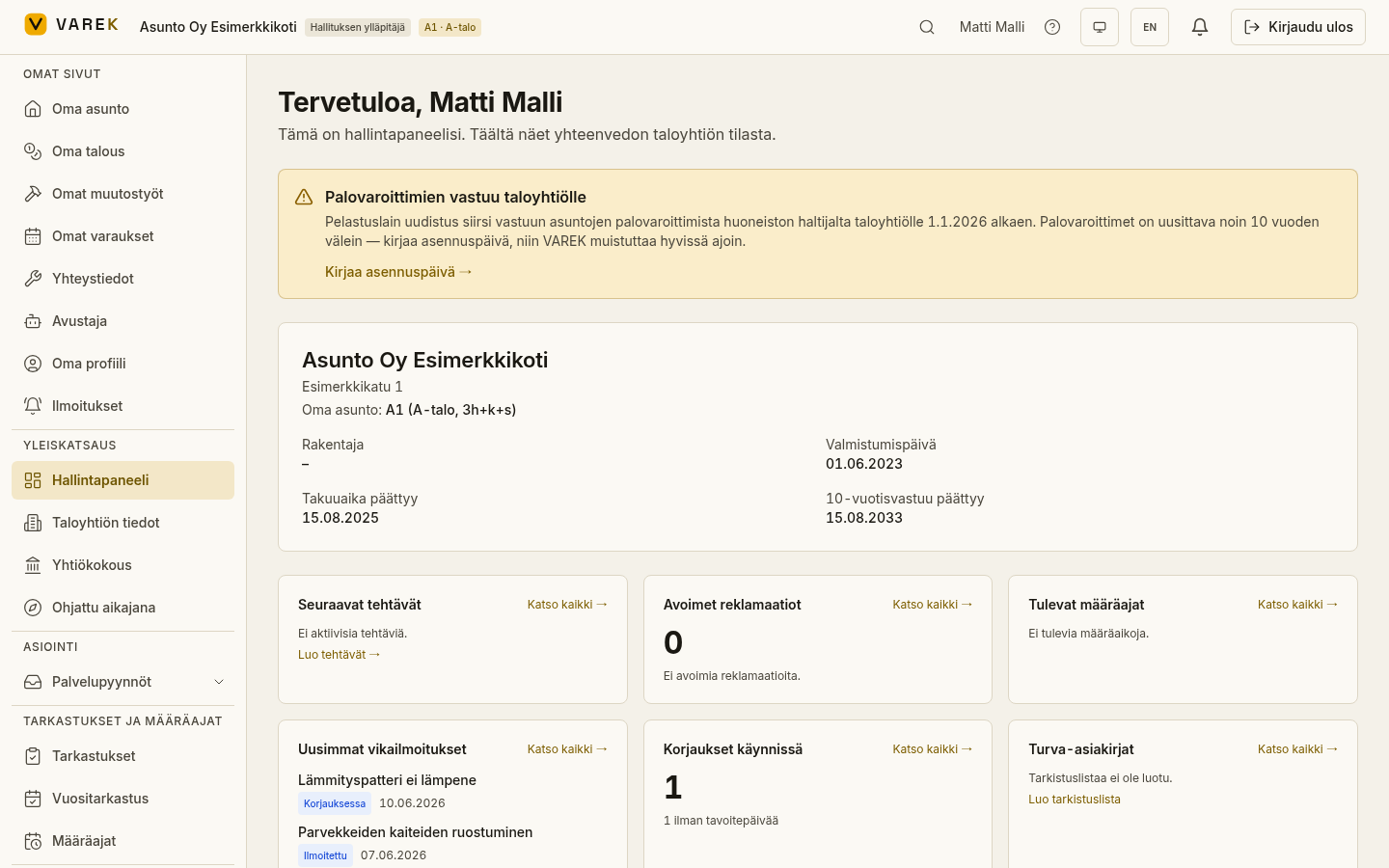
VAREK is built for exactly the gap a self-managed company falls into: there are no property manager’s systems, but all of the property manager’s tasks. One service brings the board’s work into one place:
- Situation picture and annual cycle: the board dashboard shows what is open, and the statutory deadlines — from financial statements to smoke alarms and the expiry of warranty claims — are generated automatically with reminders (warranty periods and deadlines guide).
- Finances without an accounting firm’s systems: charge invoicing with Finnish reference numbers, bank statement import and ledger matching, bookkeeping and the financial statements package — a small company’s entire money flow in one view.
- HTJ worksheets: maintenance and alteration data, share group identifiers, and financial data ready to be entered into the National Land Survey’s service (HTJ notifications guide).
- KPTS with an AI draft: the system assembles the defect, inspection, and repair history and drafts the maintenance needs assessment for the board to edit (KPTS draft guide).
- Meetings, decisions, and documents: general meetings with agendas, recorded board decisions with votes, and one archive that survives board changes — exactly what a chair needs to produce a manager’s certificate.
Self-managed does not mean left alone
A housing company without a property manager is not administration lite — it is the same company, the same statutory obligations, and the same responsibility, handled with your own hands. It works when the deadlines live in one annual cycle, decisions are recorded, and the finances run on routine. That is when the saved management fee genuinely benefits the company.
Get in touch and see how VAREK handles the property manager’s task list together with your board — without the property manager’s price tag.
This is a general guide, not legal advice. A housing company’s obligations are determined by the Limited Liability Housing Companies Act (1599/2009), the Accounting Act, the Rescue Act, the Housing Information System Act (1328/2018), and the company’s articles of association — verify your own company’s situation from the articles and, where needed, with a lawyer or accountant.
Frequently asked questions
Is a housing company required to have a property manager (isännöitsijä) in Finland?
No. Under the Limited Liability Housing Companies Act, the company must have a board, but a property manager is optional: the company may have one if the articles of association so provide or the general meeting so decides (AOYL 7:1). Especially in small housing companies it is common for the board to run the administration itself. The statutory duties do not disappear, however — they simply remain the board's responsibility.
Who issues the property manager's certificate (isännöitsijäntodistus) when there is no property manager?
The chair of the board. Under AOYL 7:27, the obligation to issue the certificate — and to make the data update referred to in section 17 a of the Housing Information System Act — rests with the chair of the board when the company has no property manager or the manager is disqualified. A reasonable fee approved by the board may be charged for the certificate and the update.
Which statutory duties remain when a housing company has no property manager?
All the same ones as with a manager: bookkeeping and the financial statements (Accounting Act), the annual general meeting within six months of the end of the financial year and the maintenance needs assessment presented there (AOYL 6:3), charge invoicing and collection, manager's certificates and Housing Information System data (AOYL 7:27), HTJ notifications of maintenance and alteration works and financial data (Act 1328/2018, as amended by 151/2023), and smoke alarms (Rescue Act — responsibility moved to the housing company on 1 January 2026).
Can a housing company give up its property manager if it has one?
Yes, but the route depends on what the manager is based on. If the articles of association provide that the company has a property manager, giving one up requires amending the articles at a general meeting. If the manager is based only on a general meeting decision, a new decision suffices. The notice terms of the property management contract must additionally be checked from the contract itself.
What are the biggest risks of a self-managed housing company?
Missed deadlines (financial statements, general meeting, HTJ notifications, expiry of warranty claims), scattered documents, decisions that leave no record, and knowledge loss when the board changes. Board members are bound by a duty of care (AOYL 1:11), so duties should not be run from memory. A clear annual cycle, recorded decisions, and one place for documents remove most of the risk.