Housing company board decision-making in Finland: what the board may decide without a general meeting
Over the course of a year, a housing company board makes dozens of decisions that never reach the general meeting: extra keys are ordered, a small repair is approved, an additional job is requested from the maintenance company. Many are agreed in the hallway, on the phone, or in an email thread — and no proper record is left behind. The Limited Liability Housing Companies Act (1599/2009), known in Finnish as AOYL, gives the board broad authority to decide the company’s day-to-day matters, but it also requires that decisions be recorded properly. This guide covers what the board may decide without a general meeting, how to document a resolution correctly under AOYL Chapter 7, and why a decision lost in an email thread is worth replacing with a traceable process.
What the board may decide without a general meeting
The general meeting is the housing company’s supreme decision-making body, but running day-to-day affairs falls to the board. Under AOYL 7:2, the board is responsible for the administration of the company and for the appropriate arrangement of its operations — precisely the practical matters that it makes no sense to bundle into a once-a-year general meeting.
There are limits, however. Far-reaching and unusual matters belong to the general meeting (AOYL 7:2). The board may not, on its own initiative, decide a matter that is unusual or far-reaching in relation to the scope and nature of the company’s activities — a major improvement project or a decision affecting the articles of association is for the shareholders to decide. When a matter is open to interpretation, it should be taken to the general meeting even if that slows things down.
In practice, board decisions fall into four tiers depending on how far-reaching the matter is and on the authority under which it is resolved.
| Type of decision | For matters such as | How it is resolved |
|---|---|---|
| Recorded assignment (AOYL 7:2/7:17) | Day-to-day administration within an existing mandate: minor maintenance, notices | Recorded immediately without a vote |
| Chair’s authorisation (AOYL 7:2.2) | Matters delegated by the board or urgent ones: key orders, damage prevention | The chair approves or rejects with reasoning; urgent measures are ratified afterwards |
| Board majority decision (AOYL 7:3) | Work orders, purchases, contracts, policies | Eligible voters vote; a majority must be in favour |
| Unanimous board decision (AOYL 7:6) | Administrative and legal matters, binding electronic decisions | Every eligible voter must be in favour |
Tip: An urgent measure — containing a water leak, for example — should always be ratified at the next board meeting. That way the decision gains the board’s endorsement after the fact, and a record survives even when the call had to be made quickly by one person.
Why an email-thread decision often goes wrong
Email feels easy: the chair proposes something, the others reply “ok”. The problems only surface later — usually when the decision needs to be verified after the fact.
- The trail fragments. The proposal sits in one person’s inbox, the replies in another. A year on, no one can find what was actually decided or on what terms.
- No numbering. AOYL 7:6 requires board minutes to be numbered consecutively. An email thread produces neither a number nor an order, so decisions can go missing without anyone noticing.
- Who voted for what? Silence in a thread sometimes means assent and sometimes means the message was never read. A dissenting opinion is easily left unrecorded altogether.
- The composition shifts. If the board changes in the meantime, it is hard to show afterwards who was eligible to vote at the actual moment of decision.
- It cannot be verified. If a decision is later challenged, an email thread is difficult to present as reliable evidence that the decision was made in the correct order.
For these reasons, board decisions are best made through a process that produces a numbered, signable, and traceable record — whether the board meets in person or resolves the matter remotely.
How to document a decision properly
The formalities of board decision-making come together in AOYL Chapter 7. Go through these before you mark a decision as made:
- Minutes are mandatory. Minutes are drawn up for a board meeting, signed by the chair and — if the board has more than one member — by at least one member the board designates for the task (AOYL 7:6).
- Consecutive numbering. The minutes are numbered consecutively and kept reliably (AOYL 7:6). Numbering makes decisions traceable and shows that nothing is missing in between.
- Dissenting opinion. A board member has the right to have their dissenting opinion recorded in the minutes (AOYL 7:6). The record also protects the member if the decision later raises questions of liability.
- Disqualification. A member may not take part in handling a matter in which their interest may conflict with the company’s (AOYL 7:4) — for example a contract to which the member is a party. A disqualified member stands aside from the decision.
How the decision is made. A board decision is the majority opinion, unless the articles of association require a qualified majority; if the votes are tied, the chair’s vote decides (AOYL 7:3). A clear voting method and a per-name record matter most in precisely the contentious cases.
Can the board decide without a meeting? Yes — the board may make decisions without convening physically, including electronically, provided it has agreed on such a procedure in its rules of procedure (työjärjestys). The obligation to draw up, number, and sign the minutes (AOYL 7:6) still applies. The bindingness of an electronic decision therefore rests on the board’s own arrangements, not on the tool alone.
How VAREK structures board decision-making
VAREK’s Decisions & assignments page puts the process described above into practice. The board records a decision, picks a category (14 ready-made ones) and an approval tier — the category prefills the tier with a legally conservative default and flags cases that actually belong to the general meeting. When the draft is submitted for approval:
- the matter receives a consecutive number (e.g. HTP-2026-001; AOYL 7:6),
- the set of eligible voters is frozen — later board changes do not shift the basis of the decision,
- voting is visible: the page shows a per-name roll-call, and a vote can carry a dissenting opinion (AOYL 7:6),
- a disqualified member (AOYL 7:4) marks themselves disqualified and is left out of the threshold,
- the decision resolves automatically once the outcome is mathematically certain — on a three-member board, the second vote in favour seals the approval.
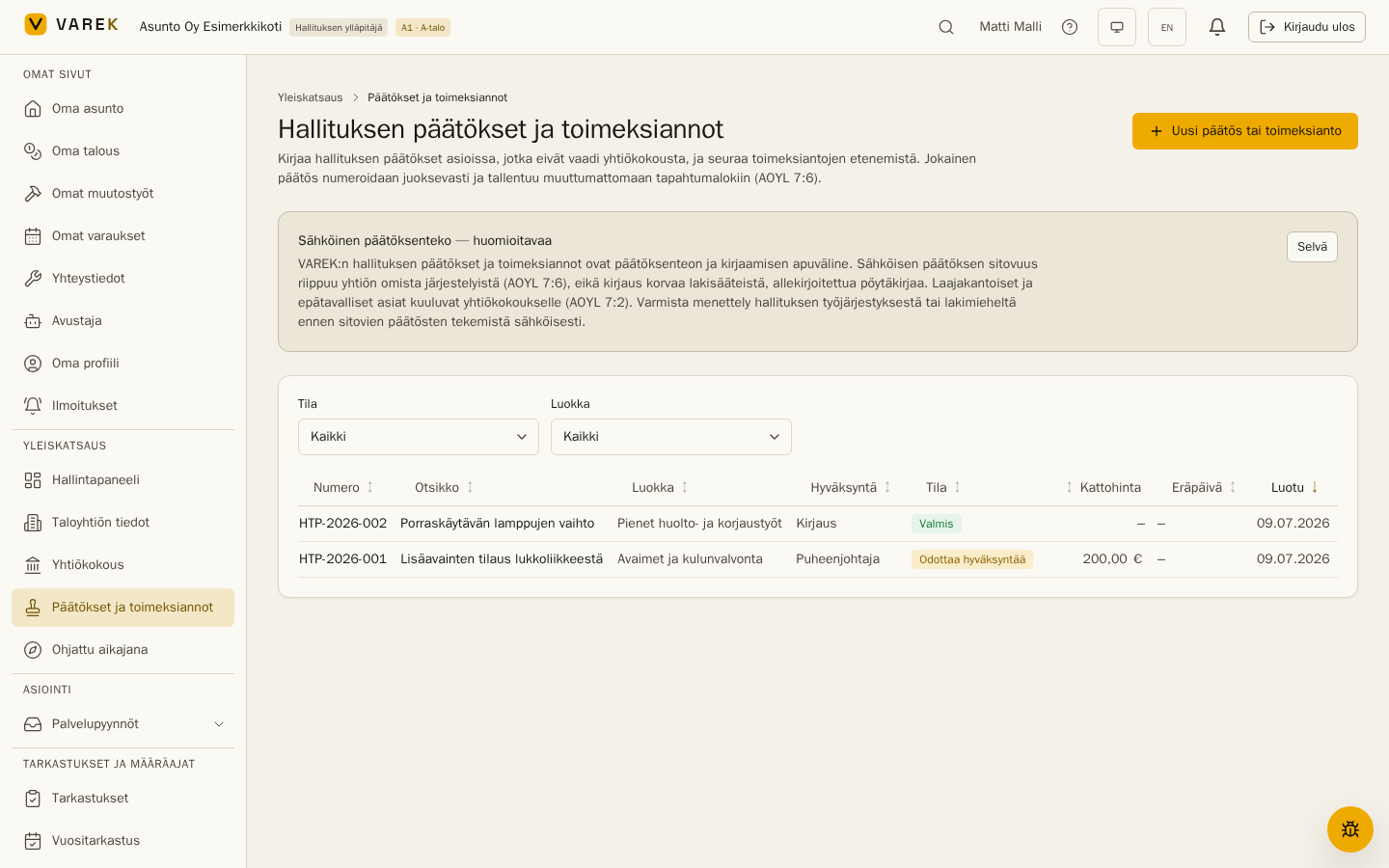
VAREK’s Decisions & assignments list brings the board’s decisions together — each gets a consecutive number, an approval tier, and a status badge.
Every step — creation, submission, votes, status changes — is written to an immutable event log whose rows are chained with a cryptographic hash; integrity can be checked with one button. A resolved matter produces a decision record (PDF) that can be stored in the board’s documents and sent to electronic signature — the same flow used to sign general-meeting minutes.
If the whole board cannot get to the app, an open decision can be sent out to vote by email link: each eligible voter receives a personal, single-use link, and the vote is confirmed on the page — merely opening the link does not cast a vote. A vote cast by email lands in the same tally and event log as one cast in the app.
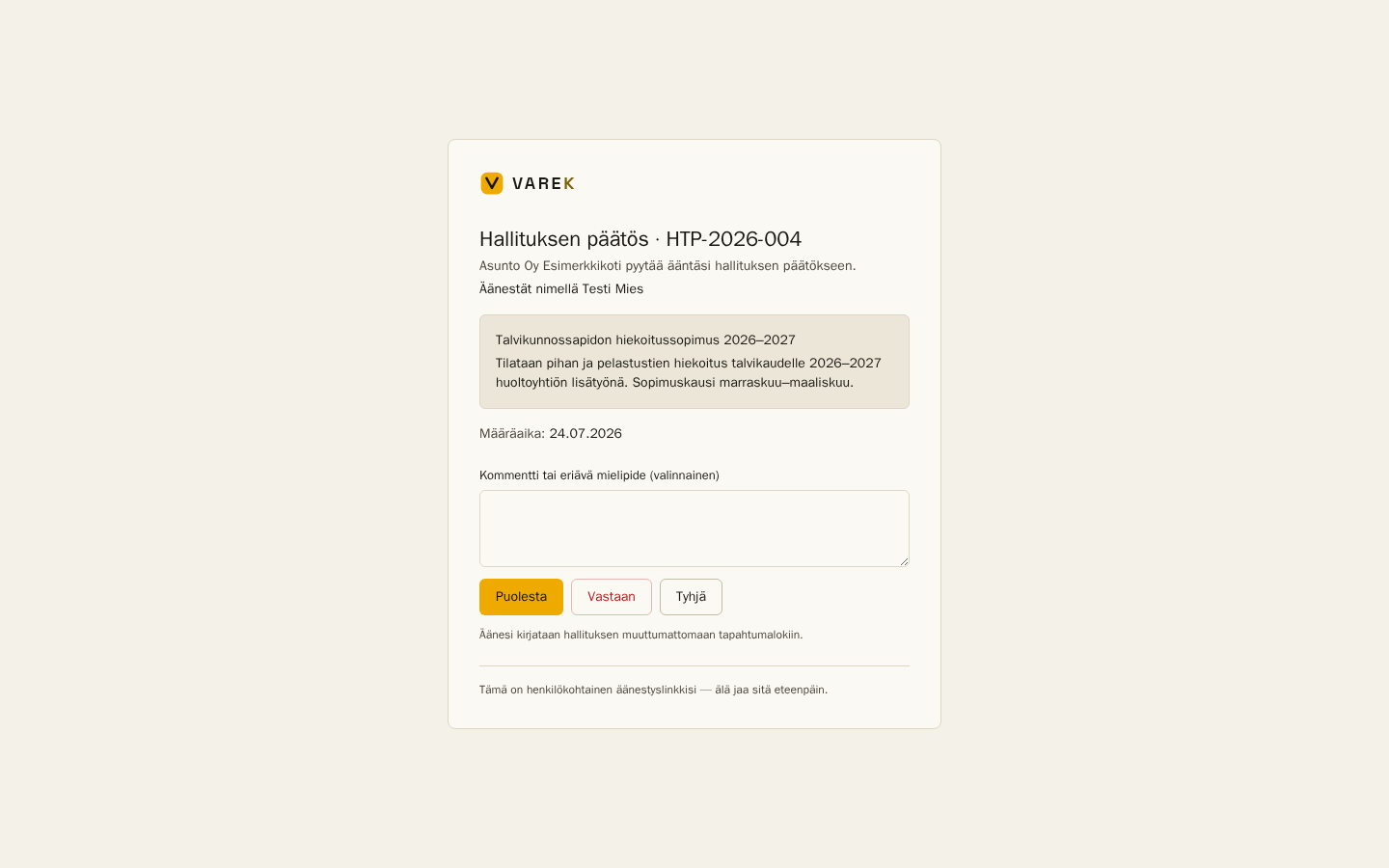
The email-link vote page shows the decision details and the deadline — a board member can vote and record a dissenting opinion without a separate sign-in.
The assignment does not then hang in the air: an approved decision can be given one or more assignees (board, shareholder, property management, maintenance company, or an external party) with roles, and its progress is tracked through the states Approved → In progress → Done. This way the whole board sees at a glance what has been decided and what is already done. A step-by-step guide is in the help center.
Bindingness — an important caveat
VAREK board decisions are a decision-making and record-keeping aid, not a legal guarantee. The bindingness of an electronic decision depends on the company’s own arrangements (AOYL 7:6), and a record in the software does not replace the statutory signed minutes. Far-reaching and unusual matters belong to the general meeting (AOYL 7:2). Before the board makes binding decisions electronically, verify the procedure from the board’s rules of procedure or with a lawyer. The tool handles the mechanics, but responsibility for the legality of decisions always rests with the housing company.
When a matter grows into one for the general meeting, it moves onto the meeting’s agenda — in VAREK an assignment can be referred directly to a meeting in preparation. See also electronic general meetings and remote voting and competitive tendering in a housing company, since many board majority decisions concern exactly a purchase or a tendering process.
Keep the board’s decisions in one place
VAREK covers board decision-making from start to finish: an approval tier prefilled by category, consecutive numbering, visible voting with dissenting opinions, a frozen composition, an immutable event log, a signable decision record, and tracking of the assignment through to done. Everything is stored in the housing company’s own system, and every step leaves a clear record.
Contact us and bring your housing company’s board decisions into a clear, traceable order.
This article is general guidance only and does not constitute legal advice. The board’s authority and the form of its decisions are governed by the Limited Liability Housing Companies Act, the housing company’s articles of association, and the board’s rules of procedure — verify the procedure and seek legal advice before making binding decisions electronically if you are in any doubt.
Frequently asked questions
What matters can a housing company board decide without a general meeting?
The board is responsible for the day-to-day administration of the company and may decide ordinary matters such as minor repairs, maintenance orders, and communications (AOYL 7:2). Far-reaching or unusual matters — for example major renovations or decisions affecting the articles of association — belong to the general meeting (AOYL 7:2). When a matter is borderline, the safest course is to refer it to the shareholders.
Can the board make a decision without holding a meeting, for example by email?
The board may make decisions without convening physically, including electronically, provided the board has agreed on such a procedure in its rules of procedure. The obligation to draw up, number, and sign the minutes still applies (AOYL 7:6). A scattered email thread does not meet these requirements, so a decision should be made through a process that produces a numbered, traceable record.
Are board minutes mandatory and what do they contain?
Yes. Minutes must be drawn up for a board meeting, signed by the chair and, if the board has more than one member, by at least one member the board designates for the task (AOYL 7:6). The minutes are numbered consecutively and kept reliably. This leaves a traceable chain showing what was decided and in what order.
How is a dissenting opinion recorded at a board meeting?
A board member has the right to have their dissenting opinion recorded in the minutes (AOYL 7:6). It is worth recording a dissent clearly alongside the decision, as it may affect a member's liability if the decision later becomes contested. In electronic voting, a dissenting opinion can be attached directly to the member's own vote.
Is a board decision made electronically legally binding?
A decision made electronically can be binding, but its bindingness depends on the company's own arrangements (AOYL 7:6), and a record in the software does not replace the statutory signed minutes. Far-reaching and unusual matters always belong to the general meeting (AOYL 7:2). Before making binding decisions electronically, verify the procedure from the board's rules of procedure or with a lawyer.