Electronic general meeting and remote voting in a housing company: what the law allows
More and more housing companies want to hold their general meeting in a way that lets shareholders participate and vote remotely — without everyone having to free up their evening and travel to a venue. The Limited Liability Housing Companies Act now makes remote participation and electronic voting possible, but how far you can go depends on your articles of association. This guide explains in plain terms what the law permits, how to run a general meeting electronically, and what to pay attention to before any binding vote.
What the law permits
The Limited Liability Housing Companies Act (1599/2009) establishes the general meeting as the shareholders’ supreme decision-making body. The rules governing general meetings are set out in Chapter 6 of the Act. When it comes to electronic and remote meetings, three distinct situations are worth distinguishing.
Remote participation in a traditional meeting
The most common and legally straightforward option is the so-called hybrid meeting: there is a physical venue, but shareholders may also join remotely — via video link, for example — and vote electronically. This is generally permitted, provided that the possibility of remote participation is stated in the notice of meeting and the connection is reliable enough for participation and voting rights to be exercised properly.
A fully remote meeting
A fully remote meeting — with no physical venue — requires an explicit provision in the articles of association permitting it. The Limited Liability Housing Companies Act was amended in 2022 to allow housing companies to include such a provision in their articles. Without it, the meeting must have a physical venue, even if remote participation alongside it remains possible.
Tip: Check your articles of association first. If you want to move to fully remote meetings, that may require amending the articles — and that decision is itself made at a general meeting, by qualified majority.
Advance voting
The Act also recognises advance voting: shareholders may cast their votes before the meeting itself if this is provided for in the articles of association, or if the board has decided to allow it and this is stated in the notice of meeting. Advance voting makes participation easier, particularly when there are many shareholders or they live in different locations.
One guiding principle is worth keeping in mind throughout: the law sets the framework, but the articles of association determine the details. The basis for votes, the vote cap, the notice period, and whether the meeting may be held entirely remotely are all governed by the articles.
How an electronic general meeting is conducted
An electronic meeting follows the same sequence as a traditional one — only the medium differs. The table below shows the process step by step, as it works in VAREK.
| Step | What happens | Points to note |
|---|---|---|
| 1. Create the meeting | The board schedules an annual or extraordinary general meeting | An annual general meeting generates a ready-made statutory agenda skeleton |
| 2. Agenda | Items are added, ordered, and described | Items subject to a vote are flagged accordingly |
| 3. Materials | Financial statements, budget, and other documents are attached | Materials are sent as attachments to the notice of meeting |
| 4. Notice of meeting | Sent to shareholders and the board within the required period | Check the notice period in the articles of association |
| 5. RSVP | Members respond: yes / maybe / no | The board can see how many plan to attend |
| 6. Voting | Voting items are opened and votes are cast electronically | The result is calculated against the applicable decision threshold |
| 7. Minutes | A PDF set of minutes is compiled and signed | Saved in the housing company’s document archive |
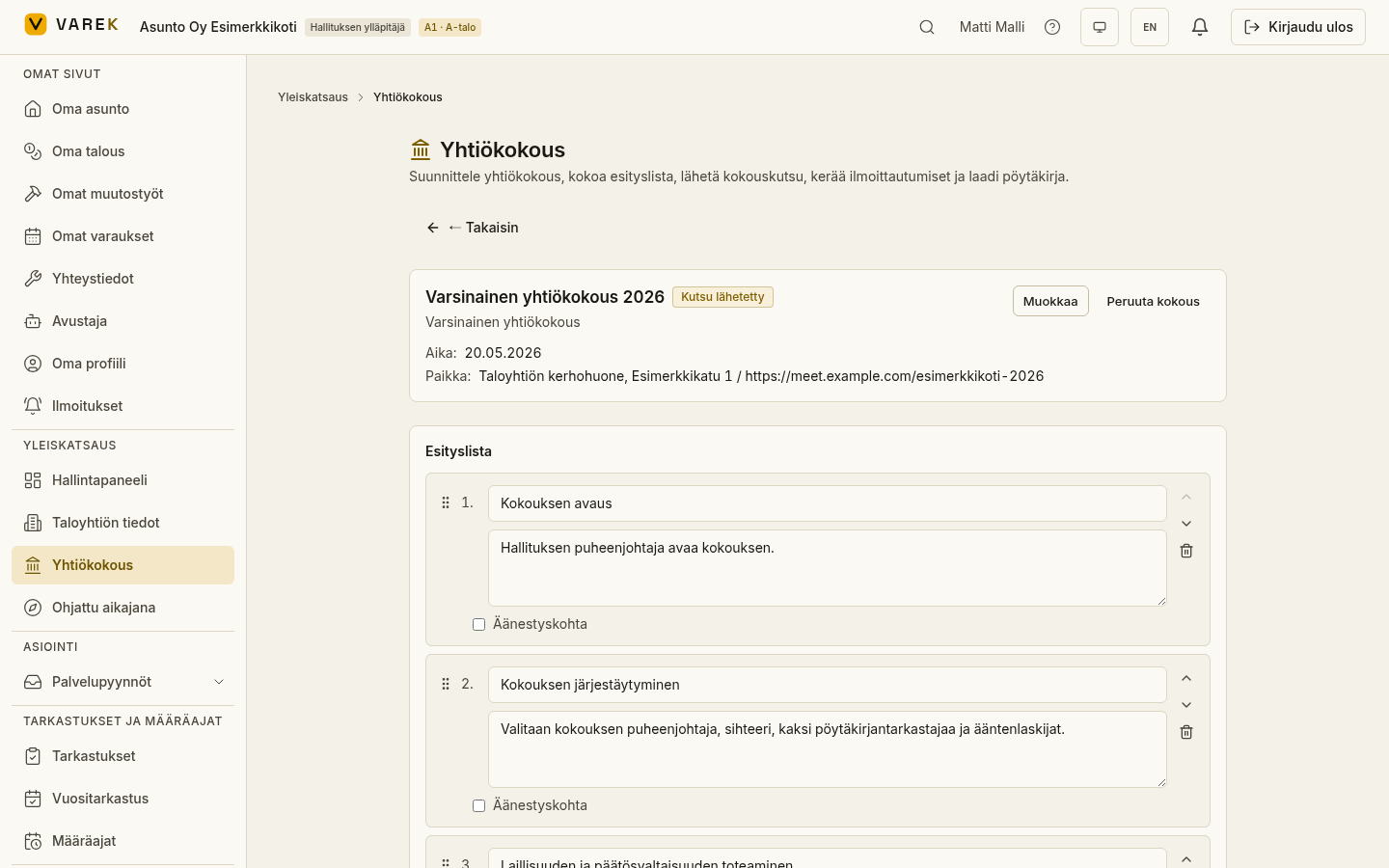
VAREK’s general meeting view brings the agenda and the status of the notice of meeting together in one place — the board can see at a glance where preparations stand.
The single most important formality is the notice of meeting and its deadline. The Limited Liability Housing Companies Act sets a window for delivering the notice: no earlier than two months and no later than two weeks before the meeting. The two-week minimum is the critical compliance floor — falling below it makes decisions open to challenge. The articles of association may require a longer notice period. Always check the correct period in your articles. The budget and maintenance charges are approved at this very meeting, so the notice should include the maintenance charge calculations and the relevant financial documents in good time.
Voting and the voting register
The heart of electronic voting is ensuring that each vote is correctly weighted. This happens through the voting register.
Number of votes and the vote cap
The general rule is that each share carries one vote — that is, votes are determined by share ownership. Some housing companies, however, vote on a per-apartment basis if their articles of association so provide.
This is where the vote cap comes in: it limits the share of the meeting’s total votes that any one shareholder may exercise. The default under the Limited Liability Housing Companies Act is one-fifth, i.e. 20% of the votes present, but the articles may raise, lower, or remove this limit. The vote cap prevents a single large shareholder from dominating the meeting unilaterally.
Before voting begins, the voting register is frozen: the number of votes is calculated for each apartment on the basis of ownership, and co-owners form a single, indivisible voting unit. The frozen register does not change during the meeting, even if ownership changes occur in the meantime.
Simple majority or 2/3 qualified majority
The decision threshold depends on the nature of the matter:
- A simple majority suffices for ordinary business such as approving the financial statements, the budget, and electing the board. The option that receives more than half of the votes cast wins.
- A qualified majority (2/3) is required for certain decisions specified in the Act, such as amending the articles of association or approving significant renovation and improvement works (AOYL 6:27). Under AOYL 6:27, at least two-thirds are required of both the votes cast and the shares represented at the meeting.
This dual threshold matters: a bare majority of votes is not enough if the proportion of represented shares falls below two-thirds. Electronic voting calculates both conditions automatically and records the outcome — passed or rejected — directly in the minutes.
Advance voting and proxies
The two practical tools for remote participation are advance voting and proxies. Both work electronically, but each has its own rules.
Advance voting
When the board decides to enable advance voting, this must be announced in the notice of meeting. Items opened for advance voting must be sent to shareholders in advance and cannot in practice be changed afterwards — otherwise the advance votes cast would no longer relate to the same matter. The meeting may still address other items not put to an advance vote. The exact rules depend on the articles of association. The notice automatically includes information about the advance voting, as the law requires.
In VAREK, a shareholder may cast an advance vote and change it up to the start of the meeting. Once the meeting begins, the advance vote becomes final. The exact deadline for changing an advance vote may vary depending on the system and the articles of association. This means a shareholder can influence decisions even if they are unable to attend the meeting at all.
Proxies
If a shareholder cannot attend and does not wish to vote in advance, they may grant a proxy to another person. The proxy holder casts votes for the authorising shareholder’s shares, and in an electronic meeting the board records all valid proxies. The key point is that no one votes twice: once a proxy is in force, the authorising shareholder may not vote until it is revoked. The vote cap still applies — the statutory default under the Limited Liability Housing Companies Act is one-fifth (20%) of the votes present, unless the articles raise, lower, or remove the limit. A single person cannot therefore accumulate unlimited votes through proxies without the articles expressly permitting it.
Tip: Advise shareholders well in advance in the notice of meeting: anyone who cannot attend can either vote in advance or grant a proxy. The more clearly this is communicated, the more shareholders will be able to make their voices heard, and the better the meeting’s quorum will be.
Minutes and signing
A set of minutes must always be drawn up for the meeting. They record the meeting details, the agenda with decisions, and the voting results: for each item voted on, the numbers for, against, and abstaining, and whether the proposal was passed or rejected.
In an electronic meeting, the minutes are produced as a compiled PDF and saved in the housing company’s document archive for shareholders to view. Signing is done via strong electronic authentication (online banking credentials or a mobile certificate): under AOYL, at least the chairperson and at least one minutes inspector must sign — check your articles of association to see whether more signatories are required. The signed minutes are returned to the document archive and must be made available to shareholders within four weeks of the meeting (AOYL 6:24). This replaces paper-based circulation and creates a clear audit trail of who approved the decisions and when.
The minutes form part of the housing company’s document register and can, where relevant, also be referenced in connection with the Finnish Housing Information System (HTJ) when the decisions relate to, for example, maintenance matters.
What to check in your articles of association
This is where the entire legal framework for an electronic general meeting comes together: the law creates the opportunity, but your articles of association determine what you are actually permitted to do. Go through these points before organising an electronic meeting or remote vote:
- Is a fully remote meeting permitted? Without an explicit provision, the meeting must have a physical venue — though remote participation alongside it remains an option.
- What is the basis for votes? By shares or by apartment.
- What is the vote cap? The statutory default is 20%, but the articles may deviate from this.
- What is the correct notice period? An insufficient notice period makes decisions open to challenge.
- Is advance voting permitted, and on what conditions?
Important caveat: a binding electronic vote must comply with the Limited Liability Housing Companies Act and the articles of association. If the meeting is intended to make significant or potentially contentious decisions — such as amending the articles of association, approving a major renovation, or taking out a company loan — it is advisable to verify that the procedure is correct with a lawyer before the meeting. The tool handles the mechanics, but responsibility for the legality of decisions always rests with the housing company.
An electronic general meeting sits within the wider governance picture — the general meeting is where finances, maintenance charges, and maintenance plans are approved. If your housing company’s governance is just getting under way, you may also find the administration handover checklist useful.
Keep the whole meeting in one place
VAREK covers the entire general meeting from start to finish: scheduling, agenda, materials, notice of meeting with its deadlines, RSVPs, voting register, electronic voting with advance votes and proxies, and signed minutes. Everything is stored in the housing company’s own system, and every step leaves a clear record.
Contact us and bring your housing company’s general meeting into the digital age — clearly, traceably, and in the right order.
This article is general guidance only and does not constitute legal advice. Whether an electronic general meeting and remote voting are permitted, and the details of how they work, are governed by the Limited Liability Housing Companies Act and your housing company’s articles of association — verify the requirements under AOYL and your articles, and seek legal advice before any binding vote if you are in any doubt.
Frequently asked questions
Can a housing company hold its general meeting entirely online?
Yes, provided the articles of association expressly permit it. The Limited Liability Housing Companies Act allows remote participation alongside a physical meeting venue, but a fully remote meeting with no physical venue requires an explicit provision in the articles of association. Always check your articles before organising a fully remote meeting.
What is a vote cap and does it apply to our housing company?
A vote cap limits the share of votes at a meeting that any single shareholder may exercise. The default under the Limited Liability Housing Companies Act is one-fifth (20%) of the votes present, but the articles of association may raise, lower, or remove this limit. Always check the correct vote cap in your articles, as it directly affects how votes are counted.
Which decisions at a general meeting require a 2/3 qualified majority?
Certain decisions under the Limited Liability Housing Companies Act require a qualified majority (AOYL 6:27): at least two-thirds of both the votes cast and the shares represented at the meeting. Examples include amending the articles of association and significant renovation or improvement works. Ordinary matters are decided by simple majority. Check the required threshold for each item in the Act and the articles of association.
Is an electronic vote legally binding?
A vote cast electronically can be binding if the meeting and the voting process meet the requirements of the Limited Liability Housing Companies Act and the articles of association — including notice period, the basis for votes, the vote cap, and decision thresholds. For binding or potentially contentious decisions, it is advisable to verify the procedure with a lawyer before the meeting.
How does a proxy work in an electronic general meeting?
A shareholder may authorise another person to vote on their behalf. The proxy holder casts votes for the shares of the authorising shareholder, and the authorising shareholder may not vote again until the proxy is revoked. In an electronic meeting the board records all valid proxies, ensuring each shareholder's votes are attributed correctly and that no one votes twice.