Smoke detectors in a Finnish housing company: responsibility moved to the company on 1 Jan 2026
At the start of 2026, Finnish housing companies gained a new permanent duty: the purchase and maintenance of apartment smoke detectors transferred from the apartment occupant to the building owner as of 1 January 2026. The change affects practically every housing company (asunto-osakeyhtiö) and rental housing company in Finland. This guide covers what the law requires, what the board now needs to do in concrete terms, and how to make smoke detectors part of the company’s normal annual rhythm — not a one-off project that is forgotten by the next board changeover.
What changed and why
Smoke detectors have been mandatory in Finnish homes for over 25 years, but responsibility for them long rested with the resident. Practice exposed the weaknesses of that model: fire inspections and accident investigations found detectors missing, incorrectly installed, too few in number, or simply too old to work.
The amendment to the Rescue Act (laki pelastuslain muuttamisesta 436/2023) fixes this by moving the obligations to the party that manages the building as a whole. The law was confirmed in spring 2023, and housing companies were given a transition period of just over two years — the obligations took force on 1 January 2026.
The new division of responsibility is clear:
| Role | Obligation |
|---|---|
| Housing company (building owner) | Purchases, installs, and maintains a sufficient number of working smoke detectors in every apartment — including battery replacement |
| Resident (apartment occupant) | Reports faults to the housing company without delay: a dying battery, a malfunctioning or detached device |
| Resident (own extra devices) | May keep additional detectors of their own in the apartment and is responsible for them |
The change does not remove the resident’s role entirely — the duty to report is an essential part of the system, because the housing company cannot see inside the apartments. But the responsibility for detectors existing, being numerous enough, and working now lies with the company.
How many detectors, and where
The minimum number of smoke detectors is set in the renewed Ministry of the Interior smoke detector decree (300/2025), which took force together with the law on 1 January 2026:
- At least one smoke detector for every 60 square metres, or part thereof, on each floor or level of the apartment. The rule is the same as before: a 45 m² studio needs one detector, a 61 m² two-room apartment needs two, and in a two-storey apartment each floor is counted separately.
- Detectors are mounted on the ceiling, at least half a metre from the walls — smoke rises, and a device near a wall or in a corner reacts too late.
- Residents’ own extra detectors and accessories connected to them (for example a vibrating alert for the hearing-impaired) are allowed on top of the minimum.
In new buildings, smoke detectors are typically mains-powered, leaving the housing company to look after backup batteries and monitor device ageing. In older housing stock, a battery-powered fleet means a regular battery-change and testing round — or a switch to long-life detectors with a sealed full-service-life battery, which brings maintenance close to zero.
The board checklist
If your housing company completed the survey and installations during the transition period, most of the list below is already done — but items 4–6 apply to every company, every year, from now on.
- Survey the current state. How many detectors does each apartment have, how old are they, and is the 60 m² rule met on every floor? The survey can be done by the maintenance company, a contractor, or the board itself with the help of a resident notice.
- Purchase and install what is missing. The transition period ended on 1 January 2026 — if installations are still outstanding, they should be completed without delay. In a larger company, the installation work is worth tendering like any other maintenance contract.
- Decide the maintenance model. Who changes the batteries and tests the devices — the maintenance company on its rounds, a contractor at set intervals, or residents following the company’s instructions? The law does not prevent organising the practical work flexibly, but responsibility for the outcome rests with the housing company. Record the model as a board decision so it binds future boards too.
- Record the installation dates. A smoke detector’s service life is typically about ten years. Remembering a renewal ten years out cannot depend on one board member’s memory — record the installation or replacement date in a system that calculates and reminds by itself.
- Instruct the residents. The resident’s duty to report only works if residents know about it. Tell them in a notice where to report a fault and that the housing company handles the fix — batteries included.
- Budget the renewal round. Replacing the whole company’s device fleet at once is a clear, tenderable purchase. Once the replacement dates are recorded, the renewal year is visible years ahead and the cost makes it into the budget in time.
Tip: Smoke detectors are best bundled into the same annual rhythm as the company’s other recurring obligations. How a housing company’s deadlines are gathered into one whole is covered in the annual cycle guide.
The ten-year trap
The most insidious feature of the smoke detector obligation is its time span. The installation project is one-off and concrete — it gets done. But the next mandatory step, renewing the whole fleet, falls roughly ten years later. In between, the board can change many times, and the board sitting in 2036 may not know what year the detectors were installed — or that they expire at all.
The same forgetting mechanism applies to all of a housing company’s long deadlines, from a new building’s warranty periods to the maintenance-needs report: knowledge is lost in board changeovers unless it is recorded somewhere that persists and reminds by itself. With smoke detectors, though, the price of forgetting is not merely legal — this is a device whose job is to wake a sleeping person during a fire.
How VAREK handles smoke detector tracking
In VAREK, the smoke detector obligation is handled by recording the installation or replacement date once — the rest happens automatically:
- Settings → Smoke alarms: the board records the installation or replacement date and the service life (default 10 years) — per building if needed, when different buildings’ detectors were replaced at different times.
- Automatic reminders: VAREK reminds the board of the upcoming renewal roughly 12 months, 6 months, and 1 month before the service life runs out — exactly early enough to tender and budget the replacement.
- Deadlines view: the smoke detector renewal appears on the same timeline as the company’s other deadlines, with countdowns.
- Dashboard notice: if no installation data has been recorded at all, VAREK reminds the board of the law change until the first record is saved.
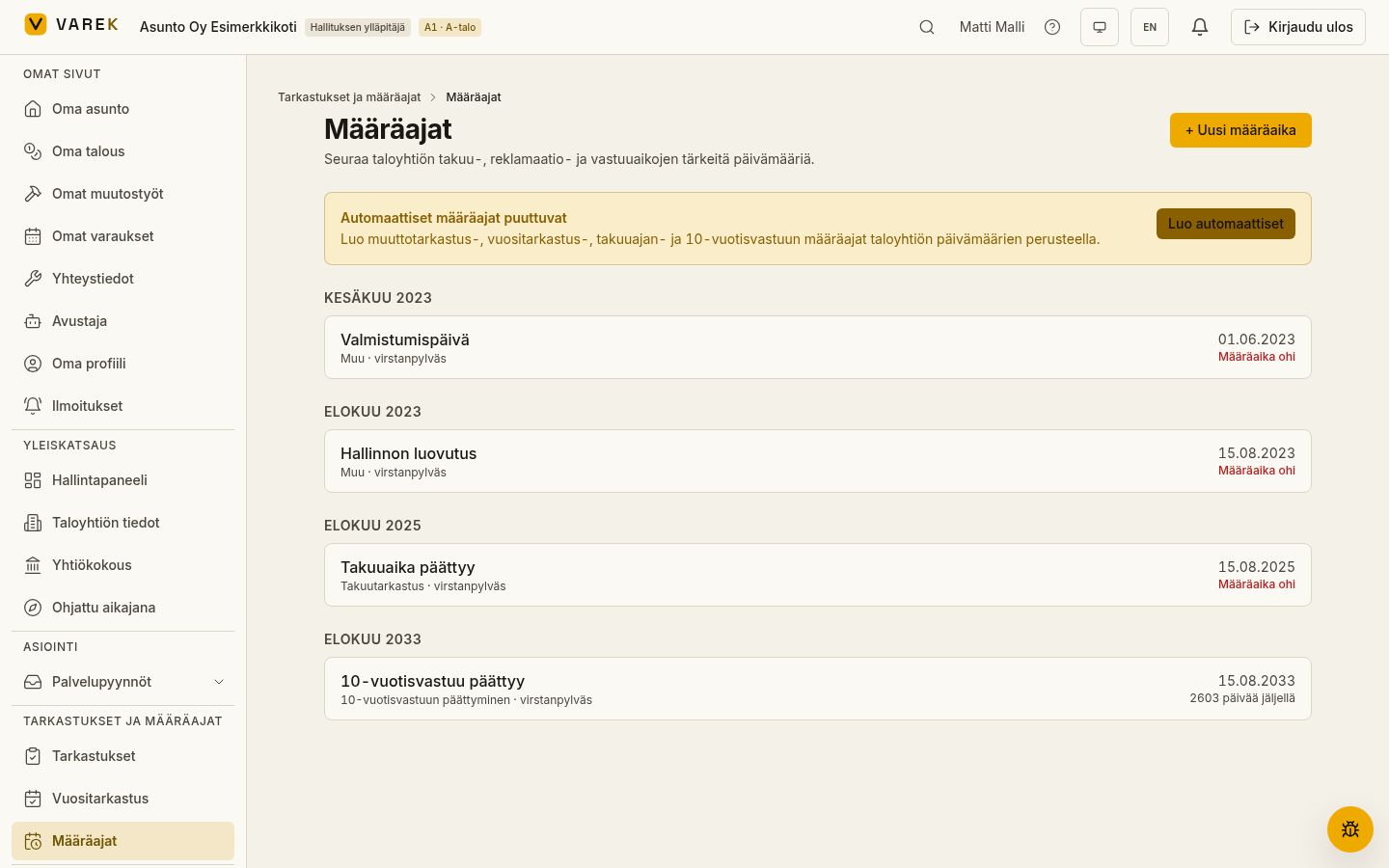
The smoke detector renewal appears in the VAREK Deadlines view alongside the company’s other deadlines — the knowledge survives even a complete board changeover.
Detailed recording instructions are on the smoke alarms help page, and how reminders work is covered in the warranty periods and deadlines guide.
Get the obligation sorted in one go
The smoke detector obligation is a permanent part of housing company life, but properly organised it is light: survey and installation once, the maintenance model minuted as a decision, installation dates into a system — and the reminders arrive by themselves a decade later.
Get in touch and bring your housing company’s smoke detectors and other deadlines into one view — recording takes a minute, the memory lasts ten years.
This is a general guide, not legal advice. The details of the obligations are set by the Rescue Act (379/2011, as amended by 436/2023) and the Ministry of the Interior smoke detector decree (300/2025) — where needed, confirm your own company’s situation with the rescue department or your property manager.
Frequently asked questions
Who is responsible for smoke detectors in a Finnish housing company in 2026?
The building owner — in practice the housing company. An amendment to the Rescue Act (436/2023) transferred the purchase and maintenance obligations for smoke detectors from the apartment occupant to the building owner as of 1 January 2026. The housing company must ensure every apartment has a sufficient number of working smoke detectors. The resident's duty is to report faults to the company without delay.
How many smoke detectors must an apartment have?
Under the Ministry of the Interior's smoke detector decree (300/2025), there must be at least one detector for every 60 square metres, or part thereof, on each floor or level of the apartment. For example, a 61 m² single-level apartment needs two detectors. Detectors are mounted on the ceiling, at least half a metre from the walls. Residents may install additional detectors of their own.
What must residents do about smoke detectors under the new law?
The resident's duty is to report smoke detector faults to the building owner — for example the housing company — without delay: a battery running out, a malfunctioning or detached device. Purchase, installation, and maintenance, including battery replacement, are the housing company's responsibility as of 1 January 2026. Residents maintain their own voluntary extra detectors themselves.
How often must smoke detectors be replaced?
According to manufacturer guidance, a smoke detector's service life is typically about ten years, after which the whole device is replaced — a fresh battery is not enough, because the sensor itself ages. The housing company should record the installation or replacement date and track the renewal date in advance, so the replacement can be tendered and budgeted in good time.
What happens if a housing company has not met its smoke detector obligation?
Finnish rescue departments enforce the obligation primarily through advice, guidance, and safety communication, and fire inspections can be carried out where needed. If the survey and installations are still unfinished, they should be completed without delay — the transition period ended on 1 January 2026, so the obligation is already in force.