Competitive tendering for a housing company: how to tender maintenance, renovations and insurance
Competitive tendering is one of the most effective tools a housing-company board has for keeping costs under control without sacrificing service quality. When maintenance, cleaning, larger renovation works, electricity supply, and insurance are put out to tender regularly and on consistent terms, the housing company pays the going market rate and does not remain trapped in an outdated contract. This guide explains why tendering pays off, what a housing company can tender, and how to write a clear request for quotation (RFQ) and compare bids objectively.
Why tender at all
Tendering is not simply about haggling on price. Handled well, it serves four goals at once:
- Cost savings. The same service is rarely identically priced between two suppliers. A contract that has been running for some time has often quietly become more expensive through index-linked price increases, while the market rate may have fallen. Tendering brings the real price level into the open.
- Quality. Writing an RFQ forces you to define precisely what the housing company actually needs. When response times, scope, and warranty terms are set out in the RFQ, the supplier also commits to them.
- Transparency. When several bids are on the table side by side, the board’s decision is easy to justify to shareholders. This also protects against suspicions of conflicts of interest or favouritism.
- Comparability. When all suppliers answer the same questions in the same format, the bids can be genuinely compared. Without this, you are comparing apples and oranges.
Tip: Start the tendering process well before the notice period on the current contract expires. A tender run under time pressure usually produces worse terms, because there is not enough time to bring the best suppliers into the process.
Cost control is part of a broader picture: income is collected through maintenance charges and expenditure is kept in check through tendering. See also Maintenance charges in a housing company.
What a housing company can tender
In practice almost all regular services and one-off contract works that a housing company buys can be put out to tender. The table below lists the most common categories and what to focus on when comparing.
| Category | Examples | What to compare |
|---|---|---|
| Maintenance and cleaning | Property maintenance, winter upkeep, stairwell cleaning | Monthly price, response time, scope of service, on-call cover |
| Technical services | Plumbing and HVAC, electrical works, ventilation, lifts | Hourly rate, call-out rate, response time, qualifications |
| Renovations and contract works | Façade, pipe renovation, roof, yard | Total price, warranty, schedule, references |
| Electricity supply | Building electricity sales | Price (¢/kWh), standing charge, contract term |
| Insurance | Property, directors’ liability, legal expenses, and voluntary work insurance | Annual premium, deductibles/excess, age reductions, indemnity limits |
Re-tendering the maintenance company is often the single highest-impact tender for a housing company, because property maintenance is an ongoing and significant line of expenditure. For larger renovations, differences in total price and warranty terms can run to tens of thousands of euros. When planning renovation works it also helps to understand how maintenance responsibility is divided between the housing company and shareholders: knowing what falls to the company and what falls to the shareholder means you commission exactly the right scope of work.
In VAREK, every tender starts by selecting the service category: Maintenance and cleaning, Technical services, Renovation and contract works, or Electricity supply. Insurance has its own tendering flow, because the comparable data points differ from those of services.
A good RFQ
The success of the entire tendering process is determined by the RFQ. The more clearly you set out what you are looking for, the more comparable the bids you receive. A good RFQ meets four conditions:
- A clearly defined subject. State precisely what is being tendered: floor areas, number of units, scope of service, or specification of works. A vague brief produces vague bids.
- The same information from everyone. Ask every bidder the same questions in the same format. Only then can the bids be placed side by side for genuine comparison.
- A clear deadline. Set a date by which bids must be submitted. Too short a deadline puts off good suppliers; too long a deadline delays the decision unnecessarily.
- The necessary attachments. Include the relevant documents — the current contract, floor plans, or the existing insurance policy. This allows bidders to price the job accurately.
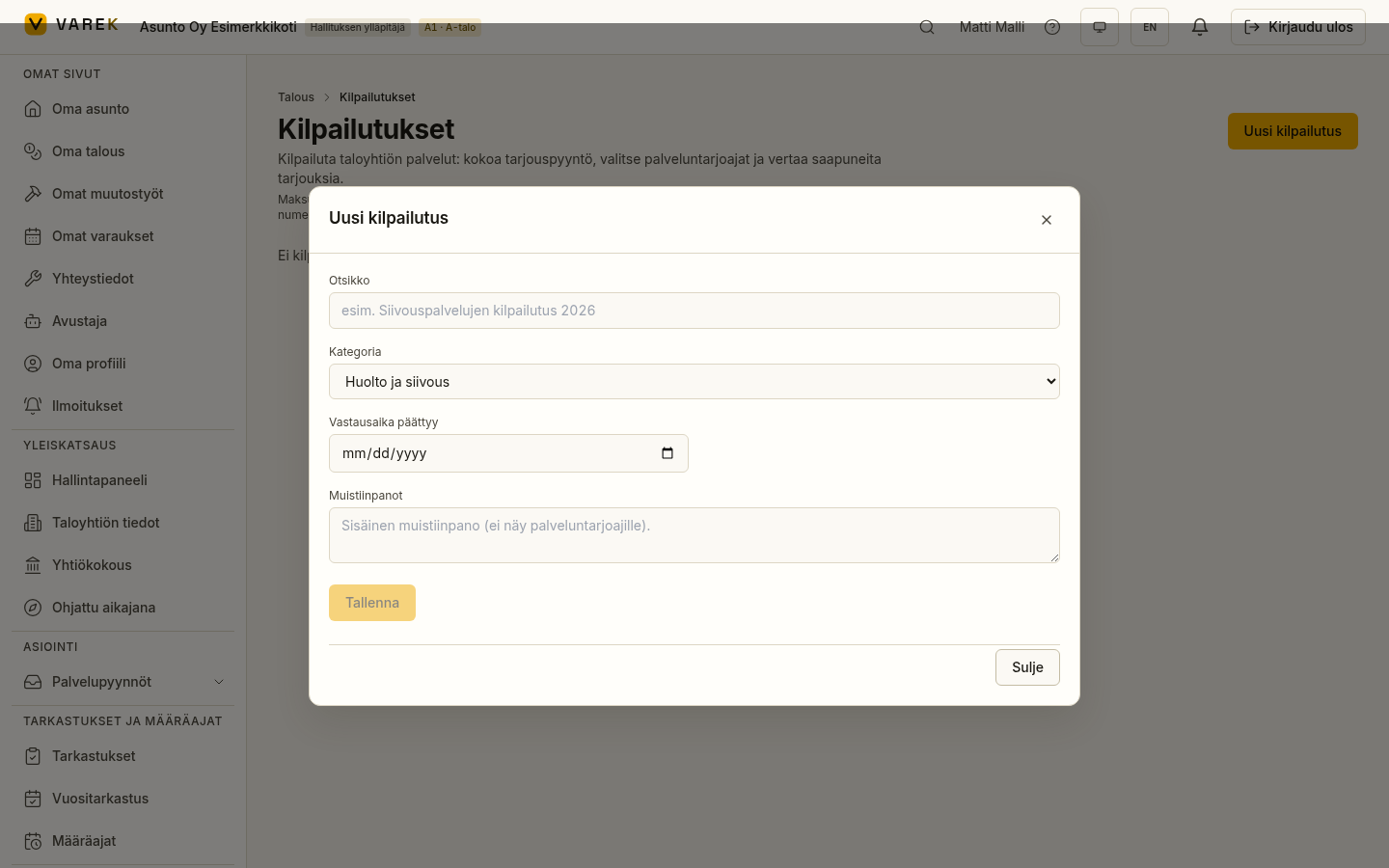
In VAREK’s tendering module, the board compiles the RFQ and selects the service providers — the housing company’s basic details are populated automatically, with no residents’ personal data included.
In VAREK, the board clicks New tender, selects the service category, enters a title and a response deadline, and describes in the notes what is being sought. The housing company’s basic details are compiled into the RFQ automatically and contain no residents’ personal data. The board then selects which suppliers to include: VAREK’s vetted Varmennettu (verified) partners and the board’s own familiar companies, which can be added by name and email address. These can be freely combined.
Once suppliers and attachments have been selected, the board clicks Send RFQ. VAREK sends each supplier a unique single-use link through which they can submit their bid without logging in. The supplier fills in a structured bid whose fields are determined by the service category: for maintenance, a monthly price and response time; for renovation works, a total price, warranty, and schedule. The supplier may also attach a PDF, and all attachments are scanned for malware.
Comparing bids objectively
Once bids have been collected in a consistent format, they can be genuinely compared. The most important principle is that price alone should not be decisive. A sound comparison weighs three things:
- Price. Monthly or total price, standing charges, and any extras.
- Quality. Scope of service, response times, qualifications, warranty, and references.
- Terms. Contract duration, notice period, index-linking clauses, and the extent of on-call cover.
VAREK displays the received bids in a comparison matrix in which the best value in each column is highlighted — for example the lowest price or the longest warranty. The board can see at a glance where a bid is strong and where it falls short. The comparison is purely numeric: VAREK does not promote any supplier on the basis of commission. VAREK earns a commission only if the board selects a verified partner, and this has no effect whatsoever on the comparison.
Tip: Decide before the bids are opened which criteria matter most. When the weighting has been agreed in advance, the evaluation stays impartial and a single low price does not distract attention from more important terms.
Decision and contract
Once you have compared the bids, the board selects the best one. In VAREK you can also decline individual bids or cancel the entire tender. Sound decision-making does not end with the selection:
- Reasoning. Record in the minutes why this particular bid was chosen. The reasoning protects the board and makes the decision transparent to shareholders.
- Written contract. Make sure the contract captures everything promised in the bid: price, scope, response times, warranty, and contract term. A verbal promise is not enough.
- Monitoring. Once the contract is under way, check that the service matches what was agreed. Deviations are far easier to address straight away than at the end of the contract period.
Special considerations when tendering insurance
Tendering insurance follows the same principle as tendering services, but the comparable data points differ. The annual premium alone is a misleading metric, because the lowest premium may mean the weakest cover. In VAREK, the insurer’s representative fills in a structured bid covering the key policy terms:
- Deductibles/excess, including a separate figure for water-damage excess.
- Age-reduction percentage and its cap — how much of a claim is left for the housing company to pay based on the age of the structures involved.
- Liability and legal-expenses sums and indemnity limits.
VAREK’s claim simulator shows how much an insurer would pay out and how much the housing company would be left to cover in, for example, a pipe-leak scenario, based on the age of the pipes. This is precisely what distinguishes good insurance from cheap insurance: the real difference between two quotes with the same annual premium only becomes apparent when a claim occurs. The connection between insurance and repair costs is explored further in What does repairing a construction defect cost — and who pays?.
Tendering is part of good housing-company governance in the same way as HTJ notifications to the Finnish Housing Information System: in both cases the point is that the housing company’s affairs are managed on time, transparently, and with full documentation.
Start tendering in VAREK
Competitive tendering for a housing company does not require a consultant or an expensive project. In VAREK, the board compiles an RFQ, sends it to the selected suppliers, compares structured bids in an objective matrix, and selects the best — at no cost. VAREK earns a commission only on the selection of a verified partner, and this does not affect the comparison.
Contact us and tender your housing company’s maintenance, renovations, and insurance through the same clear process.
This is general guidance only, not legal or insurance advice. The specifics of any tender process and the resulting contracts depend on the housing company’s individual circumstances and the supplier selected — consult a specialist where needed.
Frequently asked questions
Is a housing company legally required to put its services out to tender?
Private housing companies are not subject to the same statutory tendering obligation as public procurement, but the board has a duty of care to spend the company's funds responsibly. Running regular competitive tenders is in practice the best way to demonstrate that services are purchased at market rates and that contracts are kept up to date.
How often should a housing company re-tender its maintenance contract?
A good rule of thumb is to review key contracts every few years — typically on a three-to-five-year cycle — or whenever the quality, price, or scope of a service raises questions. Electricity supply and insurance prices move faster, so those are worth monitoring more frequently.
Do you always have to choose the cheapest bid?
No. The lowest price is not the same as the best overall package. Compare price, scope of service, response times, warranty, and contract terms side by side. Occasionally a slightly more expensive but more comprehensive contract works out cheaper for the housing company in the long run. What matters most is that the reasoning behind the decision is recorded in the minutes.
What does running a tender through VAREK cost the housing company?
Tendering is free on all VAREK plans. VAREK earns a commission only if the board selects a Varmennettu (verified) partner; service providers you add yourself generate no commission for VAREK. The comparison matrix is always based purely on the numbers, so no recommendation is skewed by commission.
Can insurance be tendered in the same way as maintenance services?
Yes. Tendering insurance works on the same principle: compile an RFQ, send it to insurers, and compare structured bids side by side. With insurance, pay particular attention to deductibles/excess amounts, age-reduction percentages and caps, and indemnity limits — not just the annual premium.