Maintenance needs assessment (KPTS) and long-term plan (PTS) in a Finnish housing company
A housing company’s buildings inevitably age, and repairs cost money. That is why the law requires the board to look ahead: at every ordinary general meeting the board must present a written maintenance needs assessment covering the next five years. This guide explains in plain terms what the statutory assessment (KPTS, kunnossapitotarveselvitys) is, how it differs from the voluntary long-term plan (PTS, pitkän tähtäimen suunnitelma), the most common mistake in preparing it — and how to build both the assessment and its financing from the housing company’s real findings rather than from a generic template.
What a maintenance needs assessment is (AOYL 6:3)
The Limited Liability Housing Companies Act (asunto-osakeyhtiölaki 1599/2009, “AOYL”) requires the board to present, at the ordinary general meeting, a written report on the need to maintain the company’s buildings and property where that maintenance materially affects the use of an apartment, the maintenance charge, or other costs arising from the use of an apartment, over the five years following the meeting (AOYL 6:3). This is the maintenance needs assessment, commonly abbreviated KPTS.
A few points are worth drawing from the provision:
- It is mandatory and annual. The assessment is not a one-off; it is presented at every ordinary general meeting. In practice the board updates it during the year with completed repairs and new findings.
- It looks five years ahead. It concerns the near future, not the building’s entire life cycle.
- It covers material matters. The assessment includes the maintenance measures that affect living, the maintenance charge, or costs — for example the facade, roof, pipes, and ventilation. Changing a light bulb does not belong here.
The purpose of the assessment is to give shareholders an advance picture of large upcoming costs — a shareholder buying or selling an apartment can see whether a major renovation and an associated charge increase are on the horizon. For the board, it is a tool for planning repairs and financing in good time rather than in a rush.
Tip: Prepare the maintenance needs assessment on the same basis as the housing company’s other maintenance records, so that the measures and their timing presented to the general meeting can also be recorded in the Housing Information System (HTJ), maintained by the National Land Survey — that way the same information does not live in two separate places.
KPTS vs. PTS — two different documents
The maintenance needs assessment and the long-term plan are often confused, because both deal with future repairs. They are, however, different things and serve different purposes.
| KPTS (maintenance needs assessment) | PTS (long-term maintenance plan) | |
|---|---|---|
| Basis | Statutory (AOYL 6:3) | Voluntary board tool |
| Horizon | 5 years | 3–30 years |
| Content | Required measures and estimated impact | Cash-flow projection: reserve + contribution − spend |
| Audience | General meeting, shareholders, HTJ | Board, accountant, financial planning |
Put simply: KPTS says what needs to be done, and PTS says where the money comes from. PTS continues where the statutory assessment ends: it stretches the same measures onto a longer timeline and calculates whether reserves and charges are enough, or whether a company loan is needed. Done well, both are built from the same information base, so no contradiction arises between them.
The most common mistake: a copy-paste assessment that does not know the building
The most common pitfall with a maintenance needs assessment is a generic template that is not based on the building’s real condition. The assessment is filled with lines resting on age assumptions — “facade in about 15 years”, “roof in about 25 years” — even though no one has gone to look at what condition the facade or roof is actually in. At worst, the same text is copied from year to year unchanged.
Three problems follow. First, shareholders lose trust in an assessment that does not match what they see with their own eyes. Second, real defects go unnoticed — a moisture problem or recurring fault does not show up in an age-based table. Third, the financing comes as a surprise when a repair falls due earlier than the template assumed.
A statutory assessment deserves better. It should reflect the housing company’s own situation — and that information already exists: in the condition survey, in the inspections carried out, and in the recorded defect reports. It is also worth remembering that some of the repairs that end up in the assessment fall under the housing company’s maintenance responsibility and some under the shareholder’s — clarifying the division of responsibility helps target the measures correctly.
How to build the assessment from real findings
A credible maintenance needs assessment is built from the bottom up: from the building’s own findings, not from a ready-made list. There are three practical sources.
1. A professional condition survey. A condition survey or investigation shows which structures are near the end of their life cycle. It is the backbone of the assessment for large projects.
2. The housing company’s own inspections. Move-in, annual, and ten-year inspections, as well as reviews of the communal spaces, constantly turn up shortcomings that belong to maintenance. In a new building especially, the annual inspection yields valuable information about what already needs repair. When the inspection findings flow straight into the maintenance plan, nothing has to be recorded twice.
3. Recorded defect reports. Recurring faults — a leaking roof, a cold stairwell, misbehaving ventilation — are the strongest signal of what needs repair in the coming years. Recorded systematically, they form the raw material for the assessment almost by themselves.
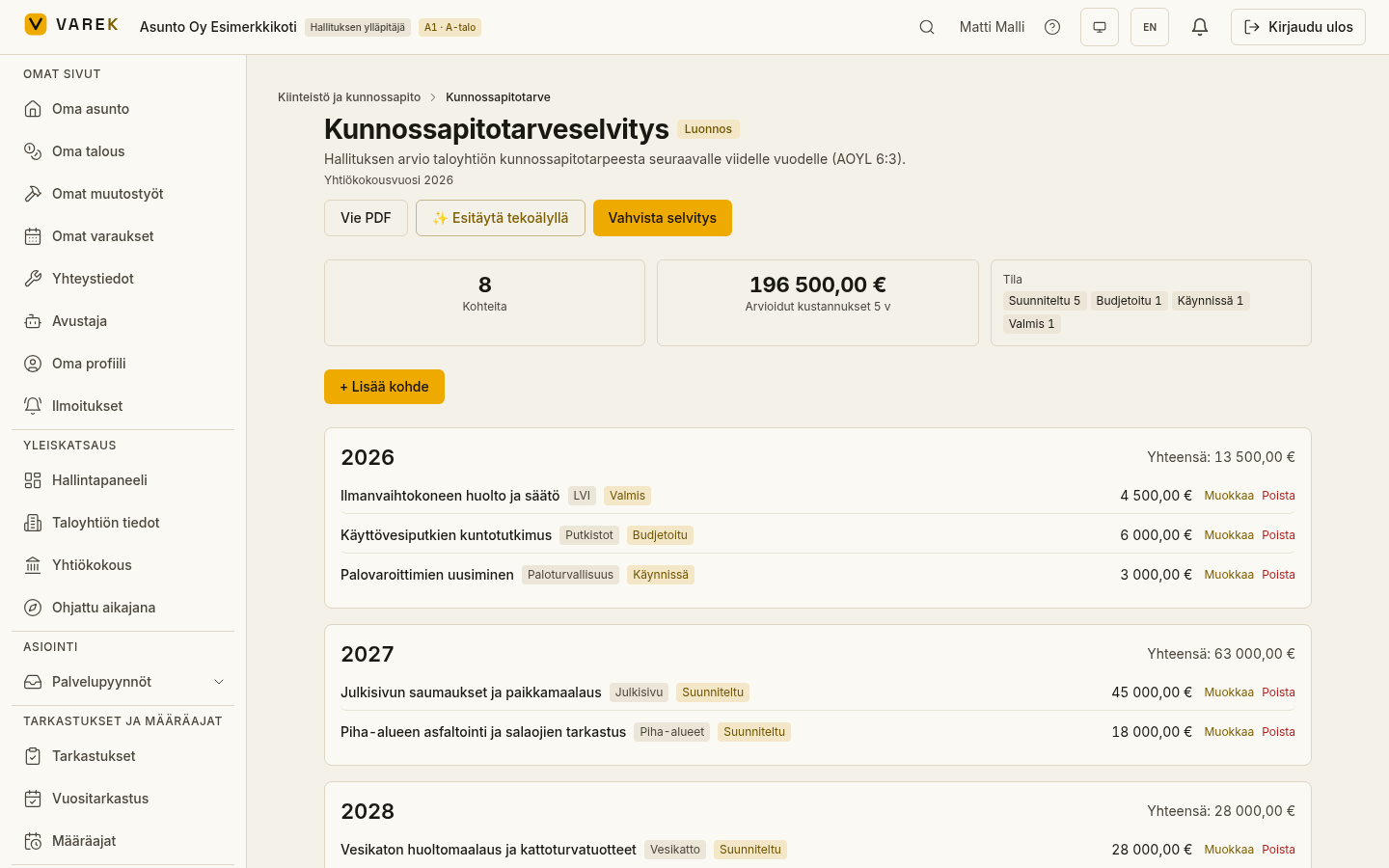
In VAREK’s KPTS view the AI suggests measures from the housing company’s own defect and inspection history — each suggestion shows which finding it is based on.
In VAREK this is built in. The AI draft on the KPTS page reads the housing company’s open defect reports, the failed inspection findings, and the precedents linked to them, and proposes measures for the next five years — not from generic building knowledge but from the housing company’s own history. Each proposal shows, as evidence chips, which finding it is derived from, and only covers the maintenance components that the Housing Information System accepts, so the text is ready for HTJ export. The board reviews every line, edits the measure text, and fills in the costs itself — the AI does not propose figures and does not replace a professional condition survey.
Alongside it works the inspections inbox: when a completed inspection contains defect findings that have not yet been added to the plan, they appear at the top of the KPTS page ready to be added with one click — without AI. This way a finding from an inspection ends up directly in the maintenance plan, and the plan line keeps a “From inspection” marker that links back to the source finding. Details: Maintenance needs assessment — AI draft.
Modelling the financing with PTS
Once the measures and their cost estimates are in place, the next question is financing — and this is where the long-term plan comes in. PTS turns the list of measures into a multi-year cash-flow projection and answers the board’s key question: is the money enough, and if not, when and by how much does it fall short? We compare the financing routes — company loan, lump-sum project payments, funds versus recognition as income — in a dedicated guide: Financing housing company repairs: loan, funds or paying at once.
The model starts from a few assumptions that the board sets once: the opening reserve (the balance of funds or the bank account today), the annual contribution (how much accrues to the reserve each year, for example from capital maintenance charges), and the horizon (3–30 years). From these, the development of the reserve is calculated for each year: opening balance plus contribution minus planned repairs.
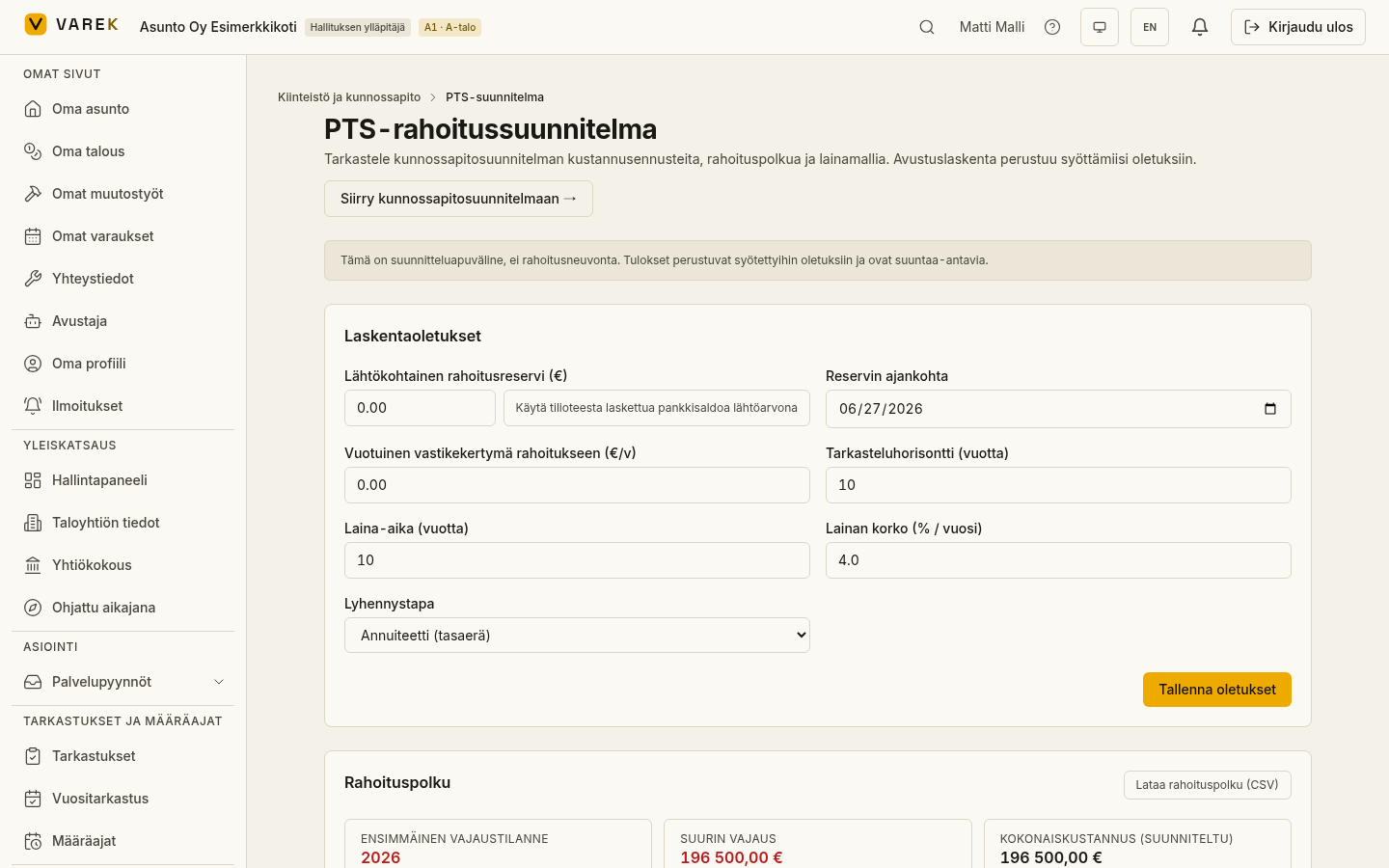
The PTS financing cockpit shows the reserve developing year by year and marks in red the years in which planned repairs exceed the available reserve.
Shortfall years are marked in red, and KPI cards show the first shortfall year, the peak shortfall, and the total cost of the planned repairs. The board sees at once in which year the reserve runs out under the current assumptions — and can try how large a charge increase or loan would cover the gap.
For an individual project, PTS models a company loan: the monthly instalment, the per-apartment capital charge, and the interest over the whole term, by the annuity or equal-instalment method. For measures that lack a cost estimate, the AI can give an indicative cost range for a building component — but these are hints based on general construction-cost data, not quotes. Always put the work out to tender before a final decision. All PTS figures are planning assumptions, not promises, and do not replace the judgement of an accountant or property manager. Details: Long-term maintenance plan (PTS) — financing cockpit.
Keep the assessment and its financing in one place
A maintenance needs assessment is not a formality to be ticked off once a year. At its best it is a living picture of the building’s condition — one that grows out of inspections and defect reports and continues straight into financial planning. VAREK brings the chain together: an inspection finding becomes a maintenance-plan measure, the measure gets a cost estimate, and PTS calculates whether the money is enough or a company loan is needed — all in one system, on the same information.
Contact us and build your housing company’s maintenance needs assessment and long-term plan from real findings — clearly, traceably, and in the right order.
This article is general guidance only and does not constitute legal advice. The content of a maintenance needs assessment and the duty to present it are governed by the Limited Liability Housing Companies Act and your housing company’s articles of association. The figures on the PTS page are planning assumptions — verify financing solutions with your accountant, property manager, or bank before making binding decisions.
Frequently asked questions
Is a maintenance needs assessment mandatory for a housing company?
Yes. The Finnish Limited Liability Housing Companies Act (1599/2009) requires the board to present, at every ordinary general meeting, a written report on the need to maintain the company's buildings and property over the next five years (AOYL 6:3). The report covers maintenance that materially affects the use of an apartment, the maintenance charge, or other living costs. It must be presented annually, not just once.
What is the difference between KPTS and PTS?
KPTS, the maintenance needs assessment, is the statutory five-year view presented to the general meeting (AOYL 6:3). PTS, the long-term maintenance plan, is the board's voluntary tool that can look up to 30 years ahead and turns the planned measures into a financing plan. In practice PTS continues where KPTS ends: it calculates whether reserves and maintenance charges will cover the coming repairs.
How many years does a maintenance needs assessment cover?
The statutory maintenance needs assessment covers the five years following the general meeting. Many housing companies also prepare a longer long-term plan (PTS) reaching up to 30 years ahead, because major repairs such as facade, roof, and pipe renovations affect finances well beyond five years. A longer horizon helps schedule the repairs and their financing sensibly.
What should a maintenance needs assessment be based on?
The assessment should be based on the real condition of the building: a professional condition survey, the housing company's own inspections, and recorded defect reports. A template based only on generic age assumptions is not enough if it does not know your particular building. When the assessment rests on genuine findings, it is both more credible to shareholders and more useful for financial planning.
How are a housing company's repairs financed?
Repairs are typically financed in three ways: from reserves collected in advance (for example capital maintenance charges and funds), with a company loan that shareholders repay as a capital charge, or with a combination of the two. In the long-term plan the board models in which year the reserve runs out and how large a charge increase or loan would cover the shortfall. The final terms always depend on the bank and the housing company's situation.