Maintenance charges in a housing company: care charge, capital charge and reference numbers
Maintenance charges are a housing company’s primary source of income. They cover everything the shared property runs on: heating, maintenance, property management, insurance and loan repayments. When charge invoicing is clear and payments are matched correctly, the company’s bookkeeping stays healthy and its cash flow remains predictable. This guide walks through how maintenance charge invoicing in a housing company works from start to finish: what a charge consists of, how the amount is determined, how invoices are generated with their reference numbers, and how payments are monitored.
What a maintenance charge is and what it consists of
A maintenance charge is a shareholder’s statutory payment obligation to the housing company. The Limited Liability Housing Companies Act (AOYL 1599/2009) requires a shareholder to pay charges in accordance with the basis laid down in the articles of association. Not all charges are the same, however — they are divided into different types depending on their purpose.
| Charge type | What it is used for |
|---|---|
| Care charge | Day-to-day upkeep and administration: heating, water, property maintenance, cleaning, property management, insurance, administration. |
| Capital charge (financing charge) | Repayment of and interest on the company’s loans — for example, financing a pipe or facade renovation. |
| Special charges | Targeted payments such as parking space, water and ground lease charges — collected only from those to whom they apply. |
The care charge is the monthly payment every shareholder is familiar with. The capital charge, also known as the financing charge, applies only to shareholders whose flat is included in the project being financed, and it can often be paid off in a lump sum. We cover the capital charge and the company-loan share in more detail in a dedicated article: Company loan and capital charge for shareholders.
Special charges are best kept separate from the base charge, because they have their own group of payers. For instance, a flat may be exempt from the ground lease charge if the shareholder owns their own portion of the plot.
Board tip: keep charge types separate in the accounts as well. When the care charge and the capital charge are clearly itemised, shareholders can see exactly what they are paying for, and the company’s financial reporting stays transparent.
How the charge amount is determined
The euro amount of a charge is not invented — it is derived from two documents: the articles of association and the budget approved by the general meeting.
The articles of association define the charge basis, i.e. how the payment is divided among shareholders. The most common bases are:
- by the number of shares (€/share) — the most common basis
- by the floor area of the flat (€/m²)
- in some cases, per flat or per occupant
The budget, in turn, specifies how much money the housing company needs to cover its costs in the coming financial year. When the total funding requirement from the budget is divided according to the charge basis in the articles of association, the charge for each individual flat is obtained. In practice, the calculation proceeds as follows:
- The general meeting approves the budget, from which the board derives and communicates the per-flat monthly charge amount.
- The charge basis in the articles of association determines how the total is split between flats.
- The board or property manager invoices the charges in accordance with the approved bases.
This is why a charge cannot be changed arbitrarily mid-period — a significant change or a budget overrun requires a general meeting resolution. Minor adjustments within the scope of the approved budget fall within the board’s authority — verify the exact threshold in your articles of association or with your property manager. Charge bases are also tied to the broader division of maintenance responsibility between the housing company and shareholders, which we address separately: Maintenance responsibility in a housing company.
Charge invoicing in practice
Once the bases are in order, invoicing is a recurring monthly routine. In practice, it is best to generate charge invoices for all flats at once in a single run — not flat by flat, manually. In VAREK, this is done with a charge run.
A charge run is a preview-and-confirm tool. You provide the charge bases (€/m², €/share, €/flat, €/occupant (requires an explicit basis in the articles of association — uncommon in practice) or €/parking space), any flat-specific exceptions, and the relevant flat details (floor area, shares, number of occupants, parking spaces). The run then proceeds clearly:
- You select the period (month) and due date.
- You click Preview and see a line-by-line breakdown per flat: amount, basis, recipient and status. Incomplete rows are flagged with a warning and skipped.
- You review the summary — the number of invoices and the total amount.
- You confirm the run, whereupon VAREK generates the invoices with their reference numbers and notifies residents.
The key element is a permanent reference number per flat. Rather than each month generating a new random reference, the same flat always uses the same permanent reference on recurring charge invoices. A Finnish reference number is built around a check digit calculated using 7-3-1 weighting, which ensures a payment cannot be posted to the wrong invoice. A permanent reference makes payment matching reliable and automatic. The same period can safely be run again — flats that have already been invoiced are not billed twice.
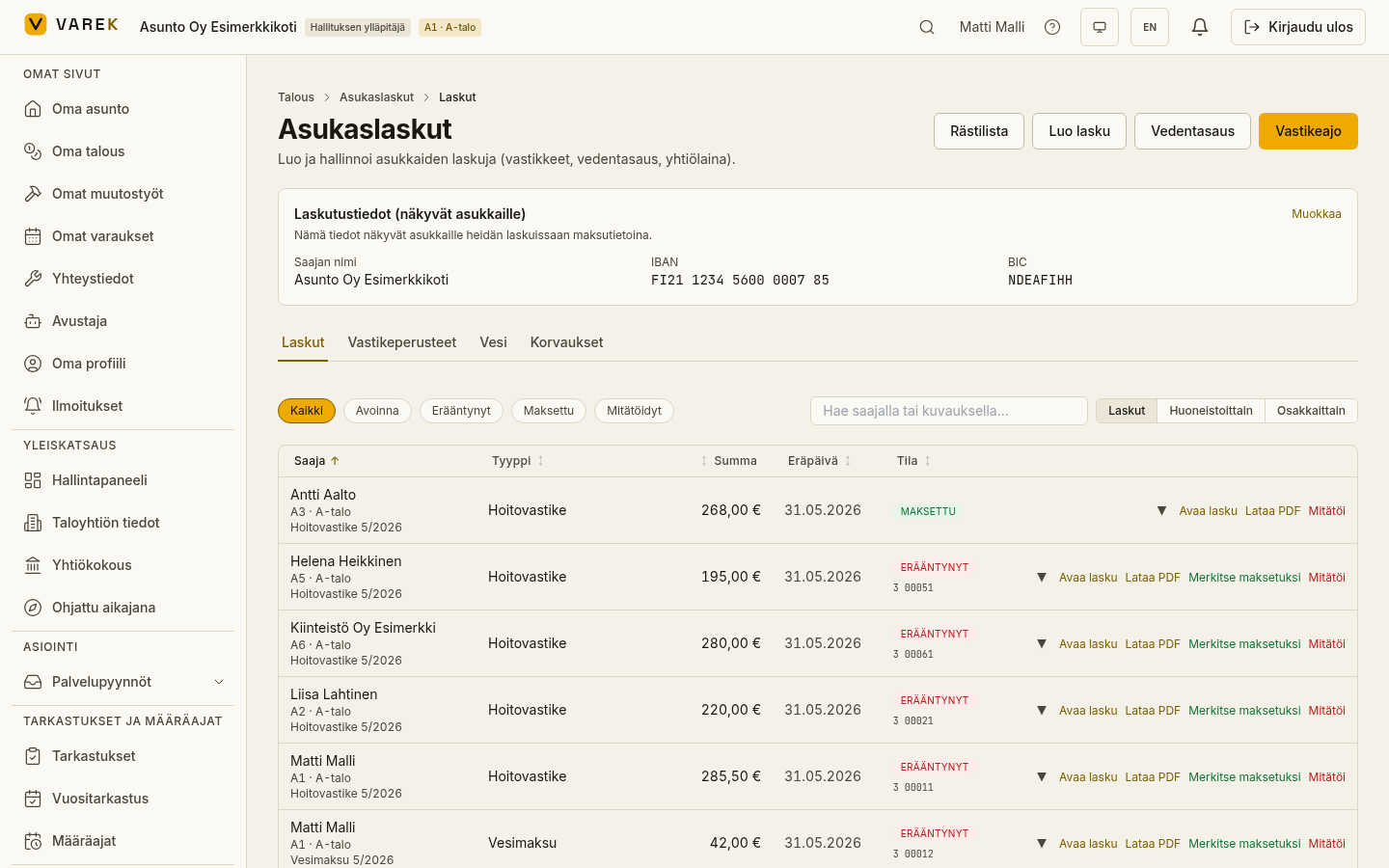
The resident invoices view brings together all maintenance charge invoices, their reference numbers and payment statuses in one place.
Generated invoices appear immediately in the Resident Invoices list and on each recipient’s My Finances page. Each shareholder therefore has their own view of their invoices and payment status.
Payment monitoring and the receivables ledger
An invoice is not yet money in the account — payments must also be tracked and matched. This is done through the receivables ledger, which records payments against invoices.
In VAREK, payment matching begins with importing a bank statement. You import a bank statement into the system and payments are matched to resident invoices via their reference numbers. Supported file formats are camt.053 (XML), OP and Nordea CSV, Nordea TITO (.nda) and Nordea HTML bank statements. The import processes one bank account statement at a time, and previously imported transactions are skipped, so no duplicates are created.
After import, transactions are grouped in a review view:
- Automatically matched — the reference number corresponds to an open invoice and the match has been applied immediately.
- Suggested — a likely match that you can accept, redirect or skip.
- Unmatched — you match these manually to the correct invoice or skip them.
Clear reference payments are matched automatically, and only ambiguous cases are brought forward for manual review. This is the core of the entire receivables ledger: permanent reference number + automatic matching = less manual work and a reliable picture of payment status.
Matched payments update invoice statuses (open → partial → paid) and the shareholder’s My Finances view. If something has gone wrong, an entire import batch can be reversed at once — the reversal removes the batch’s payments, restores invoice statuses, and reverses the bank balance. Arrears monitoring works from the same view: open and overdue charges are immediately visible, allowing the board and accountant to act in good time. Payment tracking is part of the housing company’s broader cost and financial management, which also includes competitive tendering for housing company services.
Combined invoices and water billing in brief
Two practical features make invoicing even clearer.
Combined invoices. If the same flat receives several charge types — for example a care charge, a parking space charge and a capital charge — these can be consolidated into one invoice, with each item shown as a separate line. The shareholder makes one payment instead of many, and the bank statement stays easy to read. Combined invoicing is an optional setting for the company.
Water billing. Water adjustment invoices are generated with a dedicated Water Adjustment Run tool, which uses water charge bases (€/m³) and flat meter readings. If a shareholder has paid more advance payments than their consumption warrants, the negative adjustment is generated as a credit note. This ensures water charges are based on actual consumption, not merely on estimates.
Accurate bookkeeping of charges and the related data also matters because some of this information is now reported to the Finnish Housing Information System: HTJ and the Housing Information System in a housing company.
Keep charge invoicing under control
Maintenance charge invoicing is the financial backbone of a housing company. When the charge bases are properly set up, invoices are generated in one go with permanent reference numbers and payments are automatically matched in the receivables ledger — the board and property manager always have an up-to-date view of the cash position and arrears, without manual effort.
VAREK brings charge runs, resident invoices, bank statement imports and the receivables ledger together in one view, so that maintenance charge invoicing in your housing company is clear and reliable month after month.
Contact us and make your housing company’s charge invoicing effortless.
This is a general guidance article, not legal or accounting advice. The specifics of charge bases, budgets and invoicing always depend on your articles of association and your housing company’s individual circumstances — verify the details with your property manager or accountant.
Frequently asked questions
What is the difference between a care charge and a capital charge?
The care charge covers the housing company's day-to-day administration, maintenance and upkeep costs — such as heating, property maintenance, property management fees and insurance. The capital charge (also called the financing charge) covers repayments and interest on the company's loans, for example financing a pipe renovation. The capital charge can often be paid off in a lump sum, which reduces the shareholder's individual loan portion.
How is the amount of a maintenance charge determined?
The charge basis is defined in the articles of association — typically the number of shares or the floor area (in square metres) of the flat. The budget approved at the general meeting determines how much money is needed, and the charge amount per flat is then calculated from that figure in accordance with the articles of association. The board or property manager cannot set the amount arbitrarily — a budget and a charge basis in the articles of association are both required. The charge amount is derived from the budget approved by the general meeting, but the board has authority to set the monthly instalments within that approved budget.
What is a reference number used for on a maintenance charge invoice?
The reference number uniquely identifies a payment so that it is automatically matched to the correct invoice when the shareholder pays the charge. Finnish reference numbers are generated using a check digit calculated with 7-3-1 weighting. When each flat has a permanent reference number, payments are posted to the receivables ledger without any manual processing.
Can several charges be combined into one invoice?
Yes. A housing company can invoice different charge types for the same flat on a single combined invoice, with each item shown as a separate line. This reduces the number of payments and keeps the shareholder's bank statement easy to follow.
What happens if a maintenance charge is not paid?
An unpaid charge shows up in the receivables ledger as an outstanding item. The housing company should monitor arrears regularly and send payment reminders in good time. In the case of persistent non-payment, the Limited Liability Housing Companies Act ultimately allows the flat to be taken into the company's possession, but this is an exceptional and strictly regulated measure. Always confirm the procedure with your property manager or a solicitor.