Finland's €110M energy renovation grant for housing companies (2026–2027): how boards should prepare
New state money is coming for housing company energy renovations: in its spring 2026 budget framework session, the Finnish government decided on a fixed-term renovation grant for residential buildings, with €110 million reserved for 2026–2027. One thing needs saying up front, though: applications are not open yet, and no official application timetable has been published. That is exactly why now is the best moment to prepare — when a fixed-term, limited grant pool opens, the projects that are already planned get there first. This overview covers what has been decided, what the draft decree proposes, and what a board should do now.
What the government decided
In its budget framework session on 21–22 April 2026, the government outlined a new, fixed-term energy grant for residential buildings as part of the general government fiscal plan. The core of the decision:
- €110 million for 2026–2027 — the sum covers both the grants and their administration costs.
- The grant aims at energy renovations in housing company buildings and at supporting construction sector employment: the intent is to speed up projects already being planned and to trigger new ones.
- The scheme is prepared by the Ministry of the Environment, and its model builds on the energy grant that was in use in 2020–2023.
- Eligible applicants would be housing companies and entities that own state-subsidised rental or right-of-occupancy buildings. Using a state-supported renovation loan is not required.
- The grant is planned to be administered by Varke, the Housing Finance and Development Centre of Finland. (Despite the similar name, the Varke agency has no connection to the VAREK service — the resemblance is a coincidence.)
The same framework session also outlined improvements to the state guarantee for housing company renovation loans (targeted to take effect on 1 January 2027) and increases to the residential building reserve and the household expenses credit — several levers to accelerate renovation at once.
The draft decree terms — note that these can still change
The exact terms are defined in a government decree whose draft was out for consultation from 29 May to 26 June 2026 (project YM021:00/2026). The draft’s key terms:
| Term (draft decree) | Content |
|---|---|
| Grant amount | At most €4,000 per apartment and at most 50% of approved, realised costs |
| Energy efficiency requirement | Measures must improve energy efficiency by at least 10% beyond the statutory minimum level |
| Scope | Measures that significantly improve the building’s energy efficiency — as part of a larger renovation or standalone |
| Timing | Retroactive eligibility planned for projects whose requests for tender were accepted or construction contracts signed, and works started, on 1 June 2026 or later |
| Exclusions | Not available to private individuals or to entities engaged in economic activity |
For comparison: in the previous 2020–2023 grant round, energy efficiency had to improve by at least 20 per cent beyond the statutory requirement. The draft’s 10 per cent threshold is clearly lower, which would widen the range of eligible projects. But since this is a draft, no project should be bet on any single figure yet — the consultation round also produced proposals to change the terms.
Where things stand now
The situation in July 2026:
- The decree is in further preparation after the consultation round — it has not been issued yet.
- Applications are not open, and no opening date has been published. Varke has stated it cannot yet give further information on the terms, the application process, or the timetable.
- The funds are budgeted for 2026–2027, so the grant is meant to be deployed soon — and being fixed-term, it will also end.
Two practical conclusions. First: if your housing company already has an energy renovation under way and the construction contract was signed on or after 1 June 2026, the project may be retroactively eligible under the draft — document every request for tender, contract, and start date carefully now. Second: sales-driven “apply for the grant now” pages are already circulating online. Nothing can be applied for before the official announcement — trust only the Ministry of the Environment (ym.fi) and Varke (varke.fi) on the timetable.
The board’s preparation checklist
A grant application is not written in a week, but all of its groundwork can be done in advance. This is how a project becomes application-ready:
- Update the maintenance needs assessment. An energy renovation is not a one-off stunt but part of the company’s repair plan. An up-to-date maintenance needs assessment (KPTS) shows which structures are due for repair anyway — and combining energy improvements with those repairs is where the economics work best.
- Establish the energy impact with an expert. The draft’s 10 per cent improvement requirement means the effect of the measures must be demonstrable — in the previous grant round the improvement was shown with calculations. Expect to need an energy expert’s calculation already at the application stage.
- Model the financing. Under the draft the grant would cover at most half of the costs and at most €4,000 per apartment — the rest comes from reserves or a company loan. Run the numbers both ways: with the grant and without it. A project that collapses without the grant is too fragile.
- Take the project through decisions. Significant renovations are decided by the general meeting, and the board’s preparation should be recorded as formal decisions that can be referenced later. At application time the decisions must exist, not be in progress.
- Tender and document. The draft’s timing condition rests on requests for tender and construction contracts — tender the project properly and archive every request, offer, and contract with its dates.
- Follow the official sources. When the decree is issued and applications open, the terms may differ from the draft. Check the final terms on ym.fi and varke.fi before submitting.
Tip: Tracking the grant process is best tied into the housing company’s annual rhythm alongside its other deadlines — how recurring obligations and due dates are gathered into one view is covered in the annual cycle guide.
How VAREK helps you prepare
The heaviest parts of the checklist — identifying the measures and modelling the financing — are built into VAREK:
- The KPTS page’s AI draft proposes maintenance measures from the housing company’s own defect and inspection history, with evidence references — a foundation on which energy renovations are natural to plan. Inspection findings rise into the plan with one click. Instructions: Maintenance needs assessment — AI draft.
- The PTS financing view turns the measure list into a cash flow forecast: whether the reserves suffice, and how large a loan or charge increase would cover the gap. The same project is easy to compute under two cost assumptions — full price and the grant-reduced share. Instructions: Long-term financing plan (PTS).
- The Documents section gathers the decisions, requests for tender, and contracts — at application time every attachment is in one place, not spread across three board members’ inboxes.
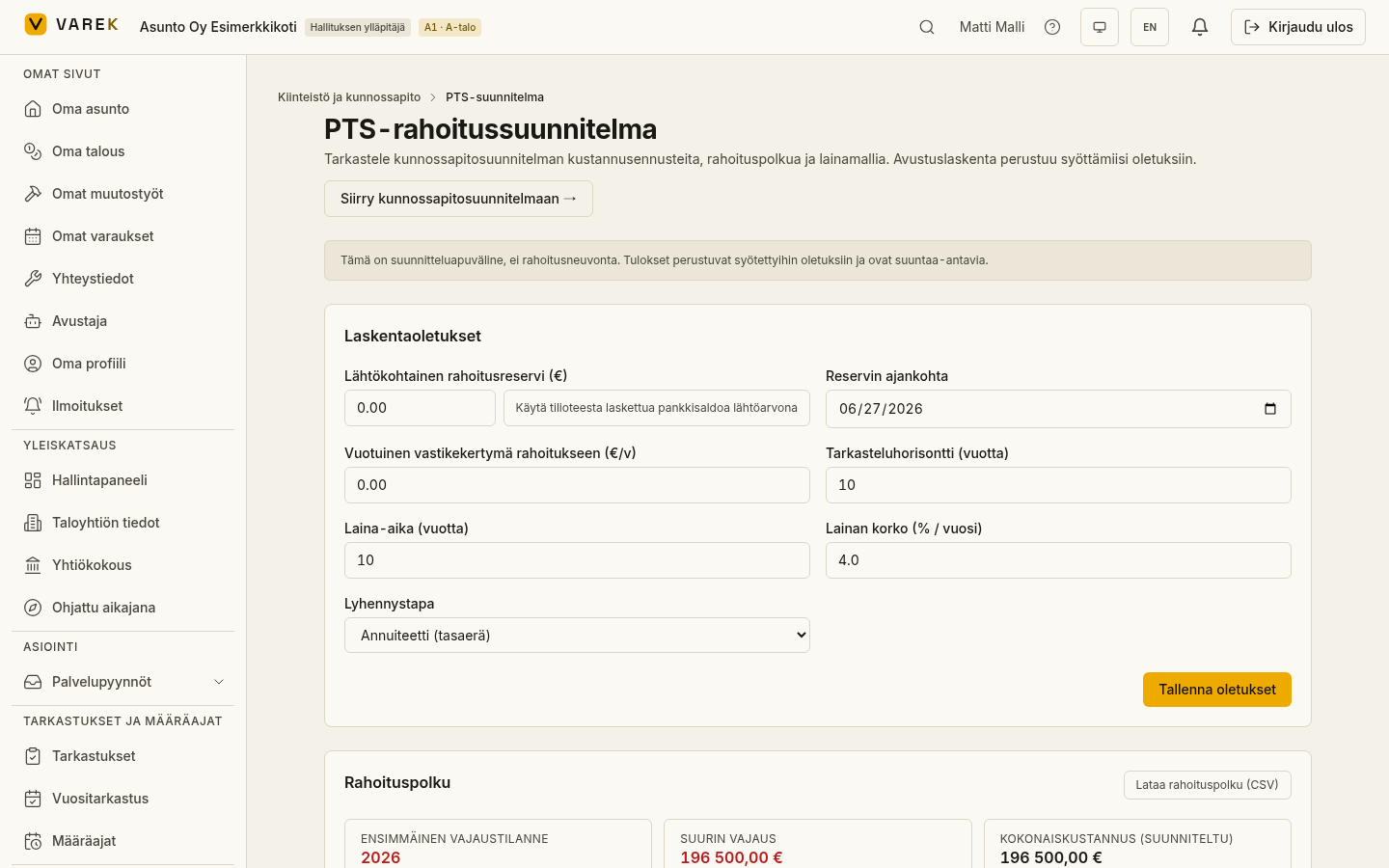
VAREK’s PTS view calculates whether the housing company’s reserves cover the coming repairs — and how much remains to be financed with loans, charges, or grants.
The ready applicant gets there first
The renovation grant is a rare opportunity for housing companies: under the draft, the state would pay up to half of an energy renovation. But a fixed-term pool does not wait — and application readiness is built in months, not days. When the maintenance needs assessment, energy calculation, financing model, and decisions are ready, the application is a formality on opening day.
Get in touch and have your housing company’s repair plan and financing model ready before applications open.
This is a general overview, not legal or financial advice. It is based on the spring 2026 budget framework decisions, Ministry of the Environment releases, and the draft decree that was out for consultation on 29 May – 26 June 2026 (VN/16661/2026), as of July 2026 — the final terms are confirmed only in the government decree. For the latest information, see ym.fi and varke.fi.
Frequently asked questions
What is Finland's new renovation grant for housing companies in 2026–2027?
In its spring 2026 budget framework session, the Finnish government decided on a new fixed-term grant for renovations that improve the energy efficiency of residential buildings. A total of €110 million has been reserved for the grant and its administration for 2026–2027. The Ministry of the Environment is preparing the scheme, and it is planned to be administered by Varke, the Housing Finance and Development Centre of Finland. Eligible applicants would be housing companies (asunto-osakeyhtiö) and entities that own state-subsidised rental or right-of-occupancy buildings.
When do applications for the renovation grant open?
Applications are not open yet (as of July 2026). The government decree defining the grant terms was out for public consultation from 29 May to 26 June 2026 and is now in further preparation. The application timetable will be announced later — the most current information is on the Ministry of the Environment (ym.fi) and Varke (varke.fi) websites. However, the grant is intended to be available retroactively for projects whose construction contract was signed and works started on 1 June 2026 or later.
How much grant money can a housing company get?
According to the draft decree, at most €4,000 per apartment and at most 50 per cent of the approved, realised costs. These figures come from the draft and may still change — the final terms are confirmed only when the government decree is issued.
What kinds of renovations would the grant cover?
The grant targets measures that significantly improve the energy efficiency of the building — either as part of a larger renovation project or as standalone measures. The draft decree requires the measures to improve energy efficiency by at least 10 per cent beyond the statutory minimum level. In the previous grant round of 2020–2023, supported measures included, for example, heating system conversions and improved thermal insulation; the exact scope of the new grant will be confirmed in the decree.
What should a housing company do before applications open?
Prepare the project so far that the application is quick to submit: update the statutory maintenance needs assessment, establish the energy impact of the measures with an expert, model the financing (the draft would cover at most half of the costs), take the project through general meeting or board decisions, and document all requests for tender and construction contracts carefully. A fixed-term, limited grant pool favours applicants who are ready.