Company loan and capital charge from the shareholder's perspective: interest, amortisation and paying off your share
When a housing company carries out a major renovation — such as a pipe renovation (linjasaneeraus/putkiremontti) — it is typically financed through a company loan (taloyhtiölaina). For shareholders, this means two things: a loan share attributable to their apartment, and repayment of that share either as a monthly financing charge or as a one-off lump-sum payment. This guide explains what a company loan and financing charge mean for your wallet, how interest and amortisation are calculated, and when paying off your loan share makes sense.
What a company loan is
A company loan — known in Finnish as a taloyhtiölaina — is a loan the housing company takes out from a bank to finance a project that cannot be covered by the regular maintenance charge. Typical projects include:
- pipe renovation (linjasaneeraus / putkiremontti)
- facade or roof renovation
- lift installation or refurbishment
- window or balcony replacement
The loan is taken out by the housing company, but it is ultimately repaid by shareholders through their apartments. Every apartment is allocated its own loan share, calculated in proportion to the apartment’s share count or floor area. The decision to take the loan and carry out the renovation is made at the general meeting — which is exactly why it pays to attend: Electronic general meeting and voting.
Tip: The loan share is not your personal bank loan — it is your portion of the housing company’s loan. You do not negotiate its terms directly with the bank; the terms are governed by the company’s loan agreement. You can, however, choose whether to repay your share gradually or in one lump sum.
Financing charge = interest + amortisation
The loan share is repaid as a financing charge (also called a capital charge or pääomavastike). This is distinct from the maintenance charge, which covers the housing company’s everyday running costs — cleaning, heating, property management, and maintenance. For more on maintenance charges, see: Maintenance charges in a housing company.
The financing charge has two components:
- Interest — the interest payable on the company loan, apportioned to your loan share.
- Amortisation / principal repayment — the portion of each instalment that reduces the outstanding principal.
The financing charge is typically billed monthly per apartment, in step with the other charges. In the early stages the interest portion is larger and the amortisation portion smaller; as the loan progresses and the principal is paid down, the ratio reverses. If the housing company uses a combined invoice, the financing charge may appear on the same invoice as the maintenance charge, shown as a separate line item.
The loan share and paying it off
A shareholder has two ways to handle their loan share: repay it gradually as a monthly financing charge, or pay it off in one go (a lump-sum payment, kertasuoritus). Both options are valid — the right choice depends on your personal finances and plans.
| Factor | Financing charge (pay over time) | Lump-sum payment (pay off the loan share) |
|---|---|---|
| Cash flow | Small monthly outgoing; cash stays available | Large one-off outlay now, but no monthly charge thereafter |
| Interest | You pay interest for the full remaining term | You save all future interest costs |
| Flexibility | Easy; requires no upfront capital | Ties up savings or requires a separate loan |
| Exposure to interest rates | Your charge moves with euribor | You are no longer exposed to rate rises on your share |
| When it makes sense | When you want to keep cash flexible or interest rates are low | When rates are high, you have savings, and you plan to hold the apartment long-term |
A lump-sum payment is usually only possible on dates specified by the housing company (for example, when the interest-rate period on the loan resets), and the terms are communicated by the property manager or accountant. Once paid off, you will no longer be charged a financing charge because you have no remaining loan share.
Tip: For investment properties, the tax treatment of the financing charge and a lump-sum payment can differ — the financing charge may be partly deductible, while a lump-sum payment is generally treated differently. Do not base your decision on the interest saving alone: verify the tax treatment with an accountant or the tax authority before making a lump-sum payment.
Interest: euribor + margin
Company loan interest almost always comprises two elements: a reference rate and the bank’s margin.
- Reference rate (euribor) varies with market conditions. Common options are 1-, 3-, 6- and 12-month euribor. For example, 12-month euribor is reset once a year, keeping the rate stable for twelve months at a time; 3-month euribor reacts to market movements more quickly.
- Margin is the bank’s fixed add-on, agreed when the loan is drawn down and unchanged for the life of the loan.
When the reference rate rises, the interest portion of the financing charge rises too — and vice versa. This is the principal reason to keep an eye on interest rates: with a variable-rate loan, your monthly instalment is not fixed. It is precisely this exposure that leads many shareholders to consider paying off their loan share when rates are elevated.
The per-ownership loan share
The same company loan is split across individual apartments. In standard Finnish practice the loan share is allocated at apartment level: the apartment’s entire share is treated as one unit. VAREK tracks loan shares per ownership, calculating each owner’s portion separately — which means one co-owner can pay off their share without affecting the others. Check with your property manager how your own housing company handles this.
VAREK records euribor rates, loans (bank margin + euribor reference period), and each shareholder’s loan share per ownership. The monthly company-loan run generates a financing charge invoice for every active share, with interest and amortisation shown as separate line items alongside the payment reference number.
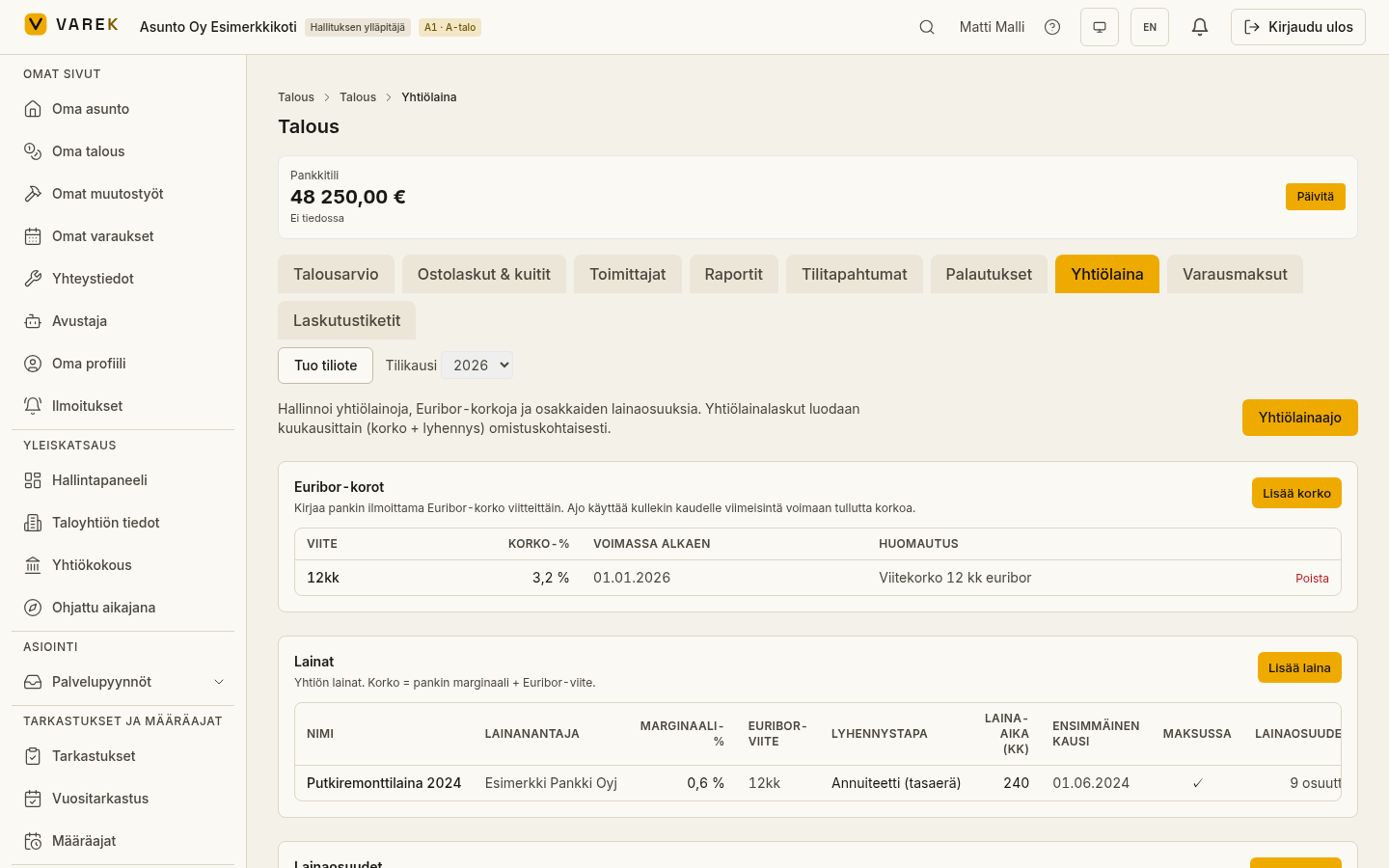
In VAREK’s company loan view, loan shares are tracked per ownership: interest and amortisation are shown separately for each owner’s share on the financing charge.
Shareholders can see their own position on the My Finances page: the outstanding principal and a history of interest and amortisation payments. Each month’s financing charge appears as a normal invoice alongside the other charges. The loan share forms part of the housing company’s financial data, which is also reported to the Finnish housing information system: HTJ and the Finnish housing information system.
What shareholders should keep an eye on
A company loan does not demand constant attention from shareholders, but a few things are worth monitoring:
- Outstanding loan share. This figure is especially important when selling — the debt-free price equals the sale price plus the loan share. Check the current figure in an up-to-date property manager’s certificate (isännöitsijäntodistus).
- Interest rate level and reference rate. Know which euribor your loan is tied to and when it resets. A rate rise feeds through to your financing charge with a time lag.
- Lump-sum payment terms and permitted dates. Ask the property manager or accountant when a lump-sum payment is possible and what the amount would be.
- Division of responsibility for repairs. A company loan finances work that falls under the housing company’s responsibility — but not every repair does. Check the boundary: Maintenance responsibility between the shareholder and the housing company.
- Tax treatment. Investors should clarify the tax treatment of both the financing charge and a lump-sum payment before acting.
With these points in hand, a company loan becomes a manageable and predictable part of housing costs — not an opaque surprise on the invoice.
Keep your company loan and financing charge under control
Company loans, financing charges, and loan shares remain straightforward when they are calculated correctly and visible to all parties. VAREK manages euribor rates, loans, and per-ownership loan shares in a single view, generates monthly financing charge invoices with interest and amortisation broken out separately, and always shows shareholders their current outstanding share.
Contact us and let company loan and financing charge administration run per ownership — automatically, without manual effort.
This article is provided for general information purposes only and does not constitute legal or tax advice. The terms of a company loan, the calculation of the financing charge, the conditions for paying off a loan share, and the applicable tax treatment all vary from case to case — always verify the specifics with your property manager, accountant, or bank.
Frequently asked questions
What is a financing charge (rahoitusvastike)?
A financing charge is the monthly amount a shareholder pays to cover the interest and amortisation on a company loan (taloyhtiölaina) taken out by the housing company. It is separate from the maintenance charge, which covers the housing company's day-to-day running costs. The financing charge is only collected from apartments (or individual owners) that still have a remaining loan share.
What does paying off the loan share mean?
Paying off the loan share — also called a lump-sum payment (kertasuoritus) — means a shareholder pays their entire portion of the company loan in one go. After that, no further financing charge is collected from them because they no longer have a remaining share. The housing company sets the terms and the permitted dates on which a lump-sum payment may be made; the property manager or accountant will provide the details.
Is it better to pay off the loan share or continue paying the financing charge?
It depends on your personal finances, the prevailing interest rate level, and whether you plan to sell the apartment. A lump-sum payment saves future interest costs but ties up capital. Paying the monthly financing charge keeps cash available but increases your total interest cost over time. Compare the loan interest rate against your other investment or borrowing options, and verify the tax treatment with an accountant or tax adviser — especially if the apartment is an investment property.
How is the interest on a company loan determined?
Company loan interest is almost always made up of two components: a reference rate (typically euribor — e.g. 1-, 3-, 6- or 12-month euribor) plus the bank's fixed margin. The reference rate fluctuates with market conditions, so the interest portion of the financing charge can rise or fall over the life of the loan.
Is the loan share visible when buying an apartment?
Yes. The outstanding loan share attributable to the apartment is part of its total price: the debt-free price equals the selling price plus the loan share. Always request an up-to-date property manager's certificate (isännöitsijäntodistus) from the property manager before completing a purchase — it shows both the loan share and the current financing charge.