The Finnish Housing Information System (HTJ): what a housing company must report, and by when
The Housing Information System (HTJ) is changing how housing company data is recorded and maintained in Finland — and a concrete deadline is imminent. Housing companies established before 1 January 2019 must submit their background data to HTJ by 30 June 2026, and from 1 July 2026 the obligation becomes continuous. This guide explains in plain language what a housing company must report, what the key deadlines are, and how the board or property manager can prepare in good time without unnecessary last-minute pressure.
What HTJ is
The Housing Information System is a national register maintained by the National Land Survey of Finland (MML) that brings together share-based apartments, ownership records, and basic housing company data in one place. Its legal basis is the Act on the Housing Information System (1328/2018).
In practice, HTJ does two things:
- Replaces paper share certificates with electronic ownership entries. Ownership of a share-based apartment is registered in HTJ in much the same way as property ownership is recorded in the land register. The paper share certificate loses its function once the apartment is entered into the register — ownership is thereafter visible from the register. The certificate is surrendered as part of the registration process, not before.
- Consolidates all essential housing company data in one place. The shareholder register, maintenance needs assessment, financial background data, and work history are all recorded in the same system, from which shareholders, buyers, banks, and authorities can view the current position.
The aim is to make housing company data reliable, current, and accessible from a single source. At the same time, the sale of a share-based apartment, its use as collateral, and the information in the property manager’s certificate are increasingly anchored to the register.
Tip for boards: HTJ is not merely a bureaucratic obligation — it is also in the housing company’s own interest. When the core data is correctly entered in the register, ownership transfers, loan arrangements, and property manager’s certificates all proceed more quickly and with fewer errors.
What a housing company must report
The background data to be compiled for HTJ falls into several categories. Boards and property managers should work through these separately, because the data comes from different sources.
Transfer of shareholder register maintenance
The housing company’s shareholder register maintenance is transferred to HTJ. From that point on, the shareholder register is maintained in the register rather than solely in the company’s own paper or electronic list. This transfer is a prerequisite for shareholders to register their ownership electronically.
Maintenance needs assessment (KPTS)
The board’s statutory assessment of maintenance requirements for the next five years (AOYL 6:3) is among the data items to be reported to HTJ. This is often the most demanding part to prepare, and we return to it in more detail below.
Financial background data
The housing company’s financial background data is compiled by share group: the remaining company loan share (debt liability) for each share group, along with the regular maintenance charges. HTJ accepts four types of maintenance charge: management charge, capital charge (financing charge), plot rental charge (tontinvuokravastike), and care charge. Usage fees, such as water or sauna charges, are excluded.
Note on double reporting: the company loan itself (balance, lender) is reported directly to HTJ by the bank. The housing company reports only the total liability per share group — the loan is not entered twice.
Completed maintenance and alteration works
The housing company’s completed maintenance projects and board-approved alteration works carried out by shareholders (for example, bathroom renovations) are compiled for HTJ. This gives buyers and authorities a picture of what has been done in individual apartments and in the building as a whole. We cover this now-continuous obligation from the board’s point of view in a dedicated guide: HTJ notification of maintenance and alteration works.
Read more about maintenance charge management: Maintenance charges in a housing company and about company loan shares: Company loan and capital charge for shareholders.
Deadlines
The key dates are worth adding to the calendar now. The obligations fall into two phases: a one-off compilation of background data, and ongoing maintenance thereafter.
| Obligation | Deadline |
|---|---|
| Compilation of background data for HTJ (housing companies established before 1 January 2019) — transfer of shareholder register maintenance + maintenance needs assessment | by 30 June 2026 at the latest |
| Continuous maintenance obligation — data kept up to date as changes occur | from 1 July 2026 |
| Annual consideration of the maintenance needs assessment | at every annual general meeting (AOYL 6:3) |
In practice, 30 June 2026 is the transition-period deadline by which existing housing companies must be in the register. After that date, the task is no longer a one-off effort but a matter of ongoing diligence: whenever the shareholder register, maintenance charges, or maintenance plan changes, the change must be entered in the register.
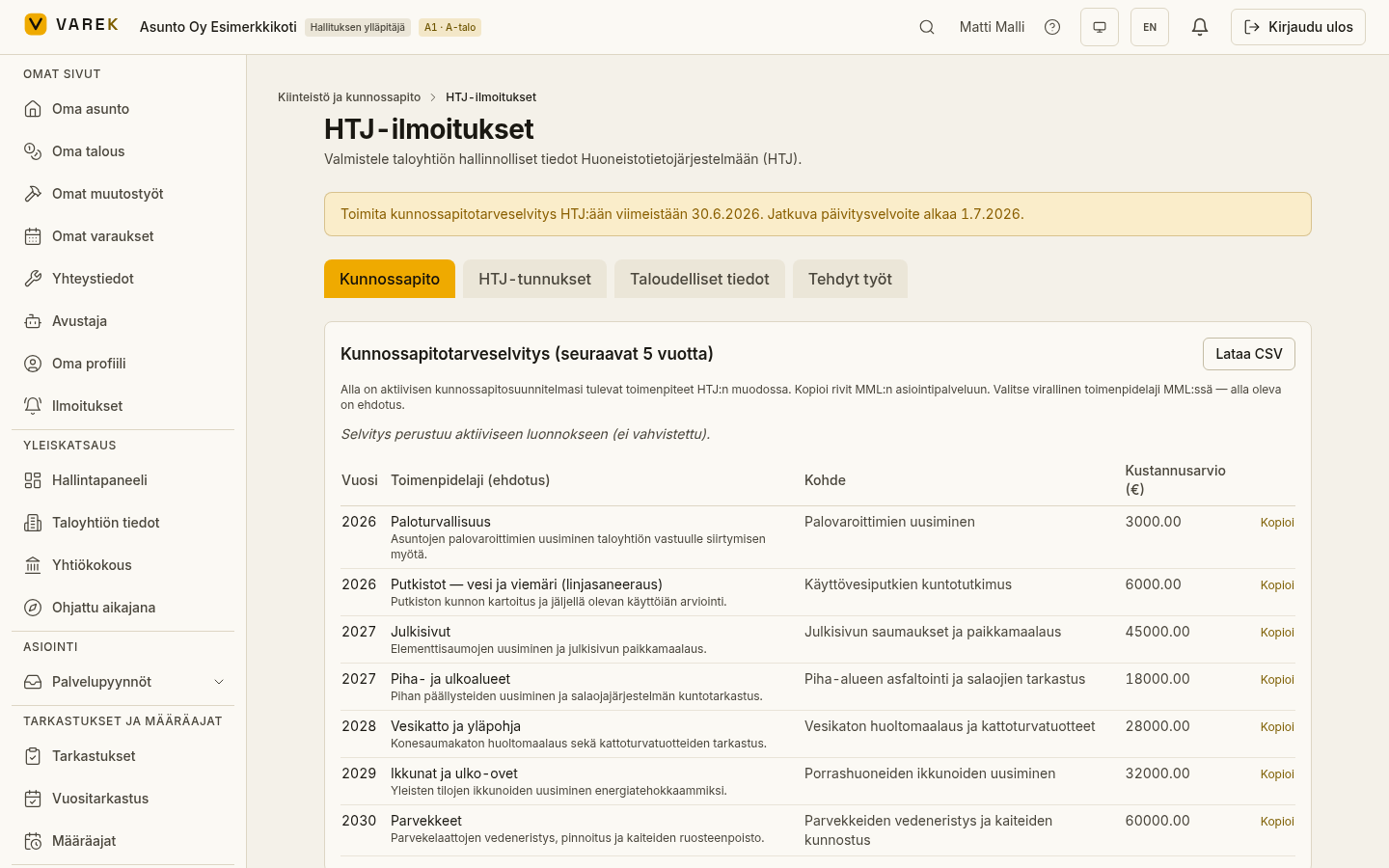
VAREK’s HTJ desk compiles the maintenance needs assessment and provides a reminder of the statutory 30 June 2026 deadline.
The maintenance needs assessment for HTJ
For many housing companies, the maintenance needs assessment is the most labour-intensive part of the HTJ data package — yet it is also an obligation that the company should already have in place.
AOYL 6:3 requires the board to present at the annual general meeting a written assessment of the building’s and property’s maintenance requirements over the next five years. The assessment describes which repairs and maintenance measures are expected and when — for example, the facade, roof, pipework, windows, and building services, component by component.
It is precisely this five-year overview that is submitted to HTJ: the building component, the planned measure, the estimated timing, and a description. For each measure, the official measure type (toimenpidelaji) must be selected from MML’s own code list.
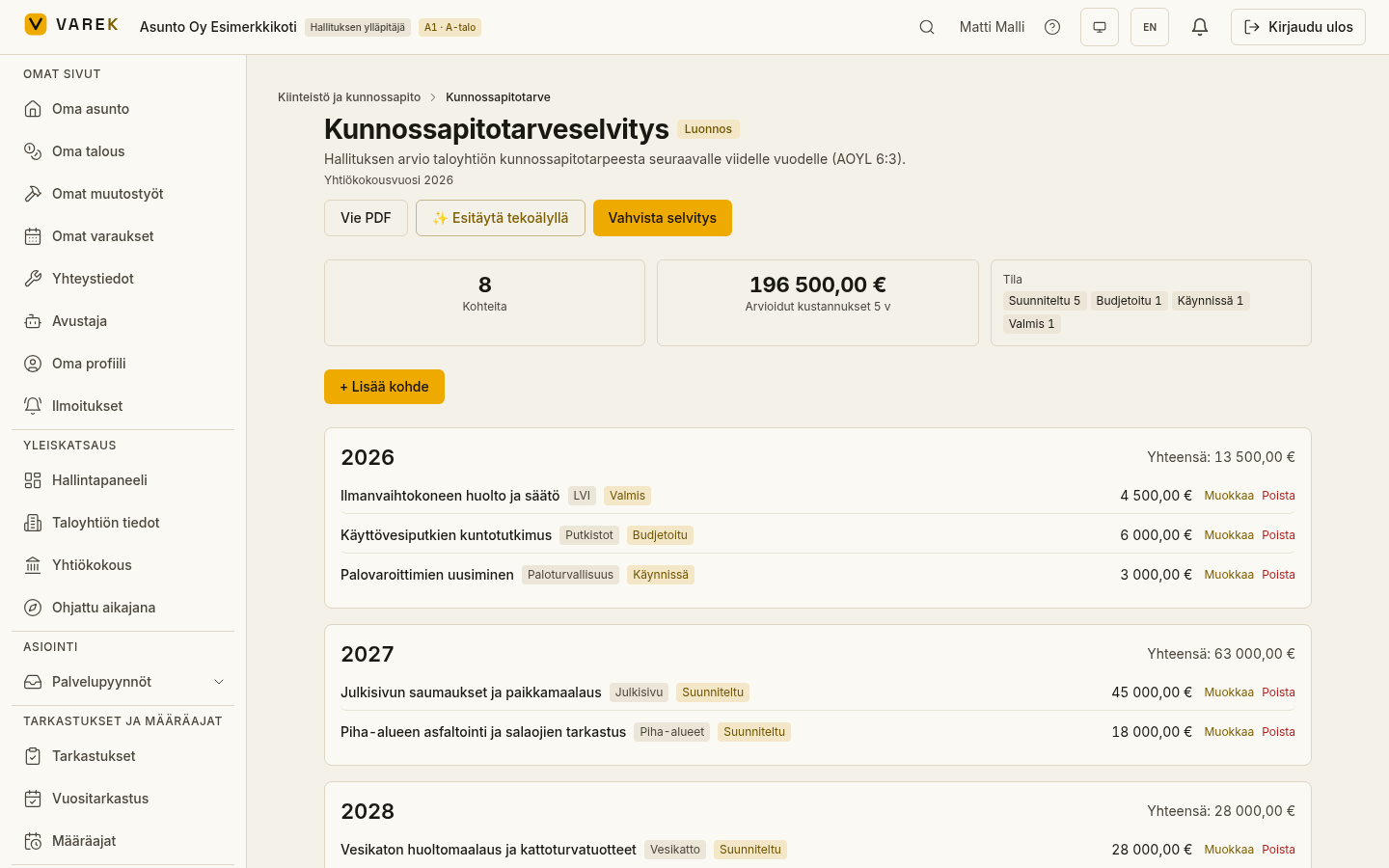
VAREK compiles the five-year repair requirements by component, including cost estimates, ready for HTJ export.
VAREK helps the board compile the assessment from the housing company’s own defect and inspection history: open defect reports, inspection findings, and linked precedents are turned into proposed measures for the next five years. The board reviews, edits, and fills in the cost estimates itself. For more on maintenance responsibility: Maintenance responsibility — shareholder and housing company.
How to prepare in practice
The HTJ obligation is not complicated when broken down into steps. 30 June 2026 is a fixed deadline — if it is approaching, act immediately. At the last moment, housing companies across the whole country will be submitting to MML simultaneously, so the sooner the material is ready, the better.
- Compile the basic data. Make sure the housing company’s name, business ID, shareholder register, maintenance charge data, and maintenance plan are up to date. Verify that every apartment has a known share group identifier (osakeryhmätunnus — a 16-character identifier by which HTJ uniquely identifies each share-based apartment).
- Draft or update the maintenance needs assessment. Work through the next five years’ repair requirements as a board and record them component by component. VAREK’s desk presents the data in a format that already matches the HTJ fields.
- Use the export desk. VAREK’s /htj page compiles the material into an export desk: you can copy the data to the clipboard or download it as a CSV file. The desk suggests measure types and building components as hints — the actual code is selected by the board in MML.
- Enter the data in MML. Log in to the MML online service using strong authentication, select your housing company, enter or paste the data copied from VAREK, and select the official measure type from MML’s code list for each measure. Submit the notification.
Note: VAREK’s /htj is an export desk that prepares the data — it does not automatically transmit it to MML and does not replace MML’s own online service. The data is always submitted by the board or property manager in MML, where the official code list is also selected.
If your housing company has a property manager, agree clearly on who submits the HTJ notifications and when. In a self-managed housing company, responsibility rests with the board.
Exemptions
Some small housing companies may be exempt from part of the HTJ obligations. The exemption may apply where both of the following conditions are met:
- The housing company has no more than five share-based apartments, and
- The housing company has no company loan (no financing charge is collected).
If your housing company meets both conditions, VAREK displays an exemption notice based on the apartment count and loan situation recorded in the system. Otherwise, the deadline obligation applies in the normal way.
⚠ Do not rely on an exemption without verification
The exemption conditions and their interpretation may change, and an exemption may not apply to all obligations. Always verify your situation with the National Land Survey of Finland or seek legal advice before deciding not to file. Responsibility for making the notification always rests with the housing company’s board.
The HTJ obligation is part of a broader digitalisation of housing company administration — the same development that is also moving general meetings and decision-making online. Read more: Electronic general meeting and voting.
Prepare for HTJ in good time
The Housing Information System affects almost every Finnish housing company, and 30 June 2026 is a fixed deadline. If it is imminent, act now — the sooner the board gets the shareholder register, maintenance needs assessment, and financial background data in order, the smoother the submission to MML will be. VAREK brings these together — compiling the maintenance needs assessment from the housing company’s own history, structuring the share group identifiers and financial data, and providing a ready export desk from which the data can be transferred to the MML online service.
Contact us and prepare your housing company’s HTJ notifications well ahead of the deadline.
This is general guidance, not legal advice. The details of HTJ obligations, deadlines, and exemption conditions may change — always verify current requirements with the National Land Survey of Finland (maanmittauslaitos.fi) or a qualified professional before submitting a notification.
Frequently asked questions
What is the Housing Information System (HTJ)?
HTJ is a national register maintained by the National Land Survey of Finland (MML) that holds data on share-based apartments, ownership records, and basic information about housing companies. Its legal basis is the Act on the Housing Information System (1328/2018). HTJ replaces paper share certificates with electronic ownership entries and brings all housing company data together in one place.
By when must a housing company submit its data to HTJ?
Housing companies established before 1 January 2019 must submit their background data — including the transfer of shareholder register maintenance and the maintenance needs assessment — to HTJ by 30 June 2026 at the latest. After that date, from 1 July 2026, the obligation becomes continuous: data must be kept up to date as it changes. Always verify current requirements with the National Land Survey of Finland.
Who submits HTJ notifications in a self-managed housing company?
If the housing company does not have a property manager, responsibility for HTJ notifications rests with the board. Board members log in to the MML online service using strong authentication and enter the data themselves. VAREK compiles the material in an export-ready format, but the actual notification is submitted by the board or property manager in the MML service.
Can a small housing company be exempt from the reporting obligation?
Some small housing companies may be exempt from part of the HTJ obligations if the company has no more than five share-based apartments AND has no company loan. However, the exemption is not automatic for all obligations, so always verify your situation with the National Land Survey of Finland before deciding not to file.
What is the maintenance needs assessment (KPTS) and why does it relate to HTJ?
The maintenance needs assessment (KPTS) is the board's statutory appraisal of the housing company's maintenance requirements over the next five years, which the Limited Liability Housing Companies Act (AOYL 6:3) requires to be presented at the annual general meeting. This assessment is one of the background data items to be reported to HTJ, making it part of the package that must be compiled before the 30 June 2026 deadline.