The housing company annual cycle and statutory deadlines: a board year plan
The work of a housing company board is, to a large extent, the management of deadlines. Some are set directly by law, some relate to the warranty periods of a newly built property, and some are practical maintenance whose rhythm repeats year after year. When these are gathered into a single annual cycle, the board sees the whole year at a glance and no deadline takes it by surprise. This guide walks through the housing company year month by month, explains which deadlines are statutory, and looks at why they are still so often missed.
Why a housing company needs an annual cycle
A housing company’s most important deadlines are few but weighty. The financial statements must be ready by a certain date, the annual general meeting must be held within the window set by law, and in a new-build property construction defect claims expire unless they are renewed in time. Yet it is precisely these deadlines that are missed remarkably often.
The most common reason is board turnover. The board is elected at the general meeting, and its composition can change every year. When a new board takes over, the previous board’s tacit knowledge — when the smoke detectors were replaced, when a defect claim must be renewed, what the schedule for the financial statements is — does not always carry forward. Deadlines are also typically far in the future: a deadline that falls due in 14 months does not feel urgent today, and that is exactly why it slips.
Tip: Do not leave deadlines to a single member’s memory or a note in a calendar. Record them in a system that reminds you automatically — then the knowledge survives even if the entire board changes.
The annual cycle solves this by making deadlines visible. It is not just a list but a board year plan that repeats identically from one year to the next and that a new board can pick up immediately.
The housing company year, month by month
The annual cycle below is built around the most common situation, in which the financial year is the calendar year. If your housing company’s financial year is different, the statutory deadlines shift accordingly — they are always calculated from the end of the financial year, not from the end of the calendar year.
| When | Board task | Basis / note |
|---|---|---|
| Jan–Mar | Close the books; prepare the financial statements and annual report | Statements ready within 4 months (KPL 3:6) |
| Mar–Apr | Statutory or operational audit | Reviewer chosen by company size |
| Apr–Jun | Annual general meeting: approve statements, budget, maintenance-needs report | Must be held within 6 months (AOYL 6:3) |
| Jun–Aug | Summer maintenance; implement meeting decisions | Practical upkeep |
| Sep–Nov | Prepare next year’s budget and charges; competitive tendering | Practical planning |
| Nov–Dec | Winter preparation; get ready to close the financial year | Practical upkeep |
| Year-round | Renew defect claims, new-build annual inspection, track smoke detectors | AKL 4:18, 3-year renewal, Rescue Act |
The backbone of the annual cycle is the spring statutory round — the financial statements and the general meeting — but some of the most important deadlines, such as renewing defect claims, run through the whole year and require continuous tracking.
The spring statutory round
The two hardest deadlines of the housing company year both fall in spring, and both are tied to the end of the financial year.
Financial statements within four months (KPL 3:6)
Under the Finnish Accounting Act (kirjanpitolaki, KPL), the financial statements must be prepared within four months of the end of the financial year. For a calendar-year company this means the statements must be ready by 30 April at the latest. In practice the work begins right at the start of the year: the books are closed for the financial year, the profit and balance sheet are compiled, and the annual report is written.
The financial statements are not a mere formality — they must be reviewed and approved at the annual general meeting. That is why the schedule should be planned backwards from the meeting date: the statements need to be audited well before the meeting so shareholders receive them as an attachment to the notice. Detailed guidance on preparing the statements is in the financial statements and annual cycle help page.
The reviewer depends on company size
Before the meeting, the financial statements go to review. Whether the company needs an auditor (tilintarkastaja) or whether an operational reviewer (toiminnantarkastaja) suffices depends on the company’s size: among other things, companies with at least 30 apartments need an auditor (AOYL 9:5). A smaller housing company can often manage with an operational reviewer, unless the articles of association or the law require otherwise. Choose and schedule the review so that the review report is ready before the general meeting.
The annual general meeting within six months (AOYL 6:3)
Under the Limited Liability Housing Companies Act, the annual general meeting must be held within six months of the end of the financial year (AOYL 6:3). For a calendar-year company the deadline is 30 June. The meeting approves the financial statements, decides on the budget and the maintenance charges, and considers the maintenance-needs report — a written account of the maintenance needs for the coming years.
The most critical formality in preparing the meeting is the notice of meeting and its deadline, which is always checked against the articles of association. The budget and the charges are approved at this very meeting, so the maintenance charge calculations should be attached to the notice in good time. The practices for an electronic meeting and remote voting are covered in a separate guide on the electronic general meeting.
New-build and warranty-period deadlines
In a newly built property the annual cycle gains a second, equally decisive layer of deadlines: the warranty periods and the expiry of defect claims. These do not follow the calendar but start from the completion of the property.
- The annual inspection takes place roughly 12–15 months after completion (Housing Transactions Act (asuntokauppalaki, 843/1994), Chapter 4, Section 18 — AKL 4:18). It is the last “easy” window to report visible defects, so preparation should begin in good time. You will find a checklist in the guide on the annual inspection.
- The warranty period lasts two years, during which the burden of proof lies with the builder.
- The ten-year liability covers serious and hidden defects for ten years.
The single most important rule, however, is this: a defect claim expires in three years unless it is renewed. This deadline is easy to forget because it does not fall on the standard points of the annual cycle but is counted from each claim’s own date. The renewal must be done before the three years are up, and it is worth flagging for tracking as soon as the claim is sent. Detailed guidance on warranty periods and renewal is in the warranty periods and deadlines help page.
Recurring obligations: smoke detectors
Some obligations do not fall in a particular month but run quietly in the background from year to year. Smoke detectors are a good example. A reform of the Finnish Rescue Act moved responsibility for apartment smoke detectors from the apartment occupant to the housing company as of 1 January 2026. Smoke detectors must be renewed roughly every ten years.
In practice the board’s task is to record the installation or replacement date and track the renewal need so that the replacement can be planned and budgeted in time. Because the ten-year cycle is long, the renewal almost certainly falls during a different board’s term than the installation — which is exactly why the information should be stored in a system rather than left to memory.
How VAREK keeps the annual cycle up to date
VAREK is built so that a housing company’s annual cycle does not depend on any single board member’s memory. The statutory spring deadlines are created automatically, and every deadline is gathered into one view with countdowns.
| VAREK feature | What it does |
|---|---|
| Automatic annual-cycle seeding | Each January it records the two statutory deadlines for the financial year that just closed, for every company that keeps books: “Financial statements ready (KPL 3:6)” and “Annual general meeting (AOYL 6:3)“ |
| Deadlines view | Gathers new-build milestones, smoke detectors, and your own deadlines in chronological order; an overdue deadline is highlighted |
| Reminders | Sends reminders well in advance — for statutory deadlines, 60, 30, 14, 7, and 1 days before |
| Dashboard countdowns | Shows the next defect claim renewal deadline with a red or amber countdown |
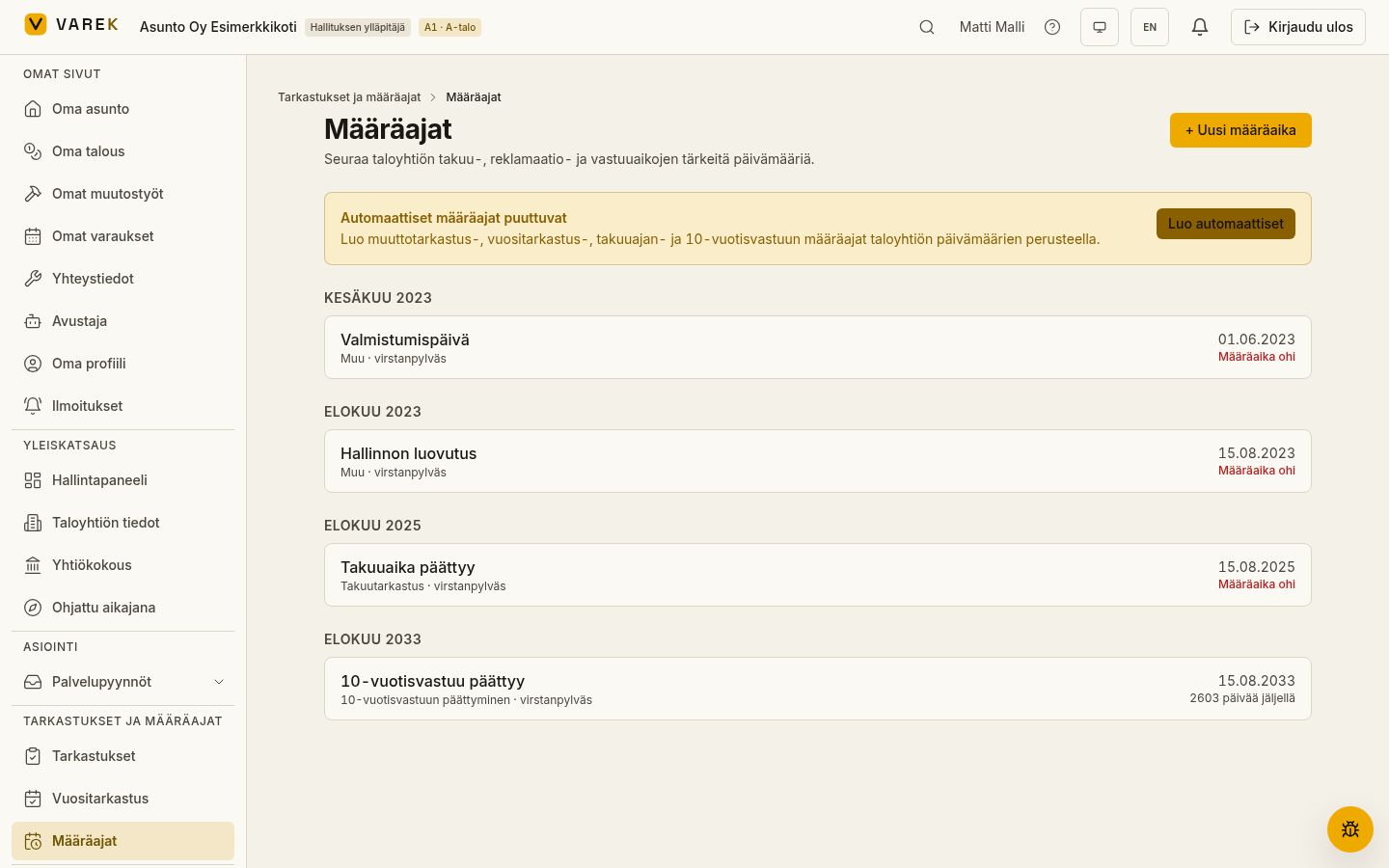
VAREK’s Deadlines view gathers a housing company’s deadlines onto a single timeline — each one shows the time remaining, and an overdue deadline is highlighted.
For the financial-statements round, VAREK provides its own annual cycle on the Accounting tab of the Finances page: it recommends the correct reviewer by company size, calculates the deadlines for the statements and the general meeting, and ticks off each step as the books are locked, the review report is attached, and the meeting is linked. In this way the same annual cycle serves both the tight schedule of the finances and the longer-horizon deadlines.
Take charge of the housing company year
An annual cycle does not remove the board’s responsibility, but it makes the year predictable: statutory deadlines are created on time, reminders arrive automatically, and the knowledge survives even if the board changes. When the financial statements, the general meeting, the warranty periods, and the smoke detectors sit on the same timeline, the board can focus on decisions rather than on watching the calendar.
Contact us and bring your housing company’s deadlines into one view — clearly, on time, and regardless of board changes.
This article is general guidance only and does not constitute legal advice. Statutory deadlines and their details are governed by the Accounting Act, the Limited Liability Housing Companies Act, and your housing company’s articles of association — confirm your own schedule against your articles and, where needed, with an accountant or auditor.
Frequently asked questions
When must a housing company prepare its financial statements?
Under the Finnish Accounting Act (kirjanpitolaki), the financial statements must be prepared within four months of the end of the financial year (KPL 3:6). When the financial year is the calendar year, the deadline is 30 April. The statements must be ready before they can be reviewed and approved at the annual general meeting, so it is best to plan the schedule backwards from the meeting date.
When must the annual general meeting be held?
Under the Limited Liability Housing Companies Act, the annual general meeting must be held within six months of the end of the financial year (AOYL 6:3). For a calendar-year company this means by 30 June at the latest. The meeting approves the financial statements, decides on the budget, and considers the maintenance-needs report. Check your own articles of association, as they may impose additional conditions.
What does a housing company annual cycle mean?
The annual cycle (vuosikello) is the board year plan that gathers a housing company's recurring tasks and statutory deadlines into a single calendar-year loop. It helps the board handle the financial statements, the general meeting, the budget, and the deadlines it must track in the right order and on time. A good annual cycle makes deadlines visible rather than leaving them to one person's memory.
Why are housing company deadlines so easily missed?
The most common reason is board turnover: when the composition changes at the general meeting, the previous board's knowledge of upcoming deadlines does not always pass to the new one. Deadlines are often far in the future and get forgotten in the day-to-day. The solution is to record deadlines in a system that reminds you automatically and well in advance, so they no longer depend on any single member's memory.
When must smoke detectors be renewed in a housing company?
Smoke detectors are renewed roughly every ten years. A reform of the Finnish Rescue Act moved responsibility for apartment smoke detectors from the apartment occupant to the housing company as of 1 January 2026. Once the installation or replacement date is recorded, the renewal need should be tracked in advance so the replacement can be planned in good time.