HTJ notification of maintenance and alteration works: a board guide
The Housing Information System (HTJ) notification duty just crossed a significant line. Housing companies had to bring their maintenance and alteration data, the maintenance needs assessment, and their basic financial data into the register maintained by the National Land Survey (Maanmittauslaitos) by 30 June 2026 — and from 1 July 2026 the data must be kept up to date continuously (Housing Information System Act 1328/2018; reporting duties expanded by Act 151/2023). The one-off effort is over: this is now an ongoing obligation that lives as the company carries out repairs and shareholders renovate. This guide explains in plain language what a board must report about maintenance and alteration works, how a shareholder’s alteration ends up in the register, and who makes the notification.
What changed on 1 July 2026
The HTJ obligation has advanced in two stages. First came the compilation of background data: companies established before 1 January 2019 had to enter share register maintenance, the maintenance needs assessment, and basic financial data into the register by 30 June 2026 at the latest. Now the second stage has begun: the continuous upkeep obligation from 1 July 2026. When the share register, charges, or maintenance plan change — or when a repair is completed in the company or a shareholder renovates — the change is entered in the register.
We covered the whole background of the HTJ, the deadlines, and the exemptions in a dedicated guide: The Housing Information System (HTJ) — what a housing company must report. This article focuses on the part that stays in the board’s day-to-day work year after year: reporting maintenance and alteration works.
What must be reported about maintenance and alteration works
Two things from different sources are entered in the register: the company’s own maintenance and repair projects and the alteration works carried out by shareholders. Both build up the “repair history” of the apartment and the company, which a buyer, bank, and authority can see from the register.
How much detail is reported depends on when the work was completed:
| Data | Completed before 1 July 2026 | Completed from 1 July 2026 |
|---|---|---|
| Company maintenance and repair projects | Briefer data: project name, main measure, year of completion | More extensive data: name, type of measure (renewal, repair, alteration, or investigation and planning), start and completion years |
| Shareholder alteration works | Report those completed after 1 June 2023 that concern the company’s structures | Report after approval or completion |
Two points are worth taking from the table. First, old projects do not have to be dug up from decades ago in full detail — those completed before 1 July 2026 may be reported more briefly. Second, shareholders’ renovations are reported only from 1 June 2023 onward, not retroactively before that. The data content and code lists evolve, so always check the current fields from the National Land Survey before reporting.
The maintenance needs assessment runs alongside this: the same five-year repair outlook that the board must by law present to the general meeting (AOYL 6:3) is also reported to the register and updated once a year. That way the same information does not live in two places — more on this in KPTS and PTS in a housing company.
How a shareholder’s alteration ends up in the HTJ
For a shareholder’s renovation the chain has two stages, and the board should know both ends.
Stage 1 — the shareholder notifies the board. A shareholder has the right to alter their own apartment, but must notify the alteration work in writing to the board or property manager in advance if it may affect a structure that is the responsibility of the company or another shareholder, or the use of another apartment (Limited Liability Housing Companies Act 5:2). This typically covers bathroom renovations, partition-wall changes, and plumbing, ventilation, and electrical modifications. A purely cosmetic renovation usually requires no notice. We went through the shareholder’s obligations and the board’s handling in more detail in a dedicated guide: The shareholder’s alteration work and alteration notice.
Stage 2 — the company reports to the HTJ. Once an alteration work concerning the company’s structures has been approved and completed, the housing company enters it in the Housing Information System as part of the apartment’s repair history. The notification is made by the company, not the shareholder. In practice, the very documentation the board received from the shareholder’s alteration notice and from supervising the work becomes the data entered in the register. That is why careful recording of alteration notices is not mere bureaucracy — it is at the same time the raw material for the HTJ notification.
Note to the board: when the alteration notice, the board’s position, supervision, and completion are recorded immediately, the HTJ notification is produced from that data almost by itself. When they are scattered across emails, the same information has to be found again years later — often just when the apartment is going on sale.
Financial data in brief
Although this guide focuses on maintenance and alteration works, they travel hand in hand with the basic financial data in the register. The company reports, per share group, the regular charges and each share group’s remaining loan share. The company loan itself — its balance and lender — is reported directly to the register by the bank, so the company reports only the per-share-group loan share, not the loan twice. We cover the basics of loan shares and the capital charge here: Company loan and capital charge for the shareholder.
Who makes the notification
The notification is made by whoever runs the company’s administration: the property manager or the board. If the company uses a property-management system, the data can be transferred to the register directly from that system via an interface — ask your system vendor whether it supports the transfer. A company without a property-management system enters the data in the National Land Survey’s online service with strong authentication.
If the housing company has no property manager, the responsibility is the board’s. Under AOYL 7:27, the obligation to make the data update referred to in section 17 a of the Housing Information System Act rests with the chair of the board when the company has no property manager or the manager is disqualified. In a self-managed company the HTJ notifications are therefore on the chair’s desk alongside the property manager’s other tasks — we compiled this in the guide A housing company without a property manager. If the company has a manager, agree clearly on who makes the notifications and on what schedule.
Exemptions — do not assume without verifying
Some of the smallest housing companies may be exempt from the obligation, but the conditions are strict and both must hold:
- The company has at most five residential shareholding apartments, and
- The company has no company loan distributable to shareholders.
Even so, the exemption is not absolute. If a shareholder, bank, or estate agent requests that the data be updated in the register — for example in connection with an apartment sale — the data must be reported, even if the company would otherwise be exempt by its size. In practice, even a small company has reason to keep the data ready.
⚠ Always verify the exemption with the National Land Survey. The interpretation of the exemption conditions may change, and the exemption may not cover every obligation. Responsibility for making the notification always rests with the housing company’s board.
How a board keeps the data up to date
The ongoing obligation is not heavy when tied into normal operations:
- Record immediately. Note a completed maintenance project and a shareholder’s approved alteration work when it is completed — not only when the register is being updated.
- Update at least once a year. In practice the most natural moment is after the general meeting, when the financial statements, charge data, and maintenance needs assessment have just been handled.
- Keep share group identifiers in order. Every residential apartment is identified in the register by a share group identifier — without it, data cannot be allocated correctly.
- Select the official code list at the National Land Survey. Measure types and building components are chosen from the National Land Survey’s own code list when making the notification.
VAREK keeps the HTJ data ready
VAREK does not send data to the National Land Survey on your behalf — the actual notification is always made by the board or property manager in the National Land Survey’s service. But it removes the most laborious part: finding and compiling the data.
- Alteration notice register: shareholders’ alteration notices, the board’s position, conditions, supervision, and completion are recorded in one place. The apartment’s alteration history stays intact — exactly the material entered in the HTJ and required for a property manager’s certificate.
- HTJ worksheets: maintenance and alteration data, share group identifiers, and basic financial data compiled into an export format you can copy or download as CSV and enter into the National Land Survey’s service. The worksheet suggests measure types as hints — you select the official code yourself in the register (HTJ notifications guide).
- The maintenance needs assessment ready for the same export: the system assembles the assessment from the company’s own defect and inspection history and keeps it consistent with the data entered in the HTJ.
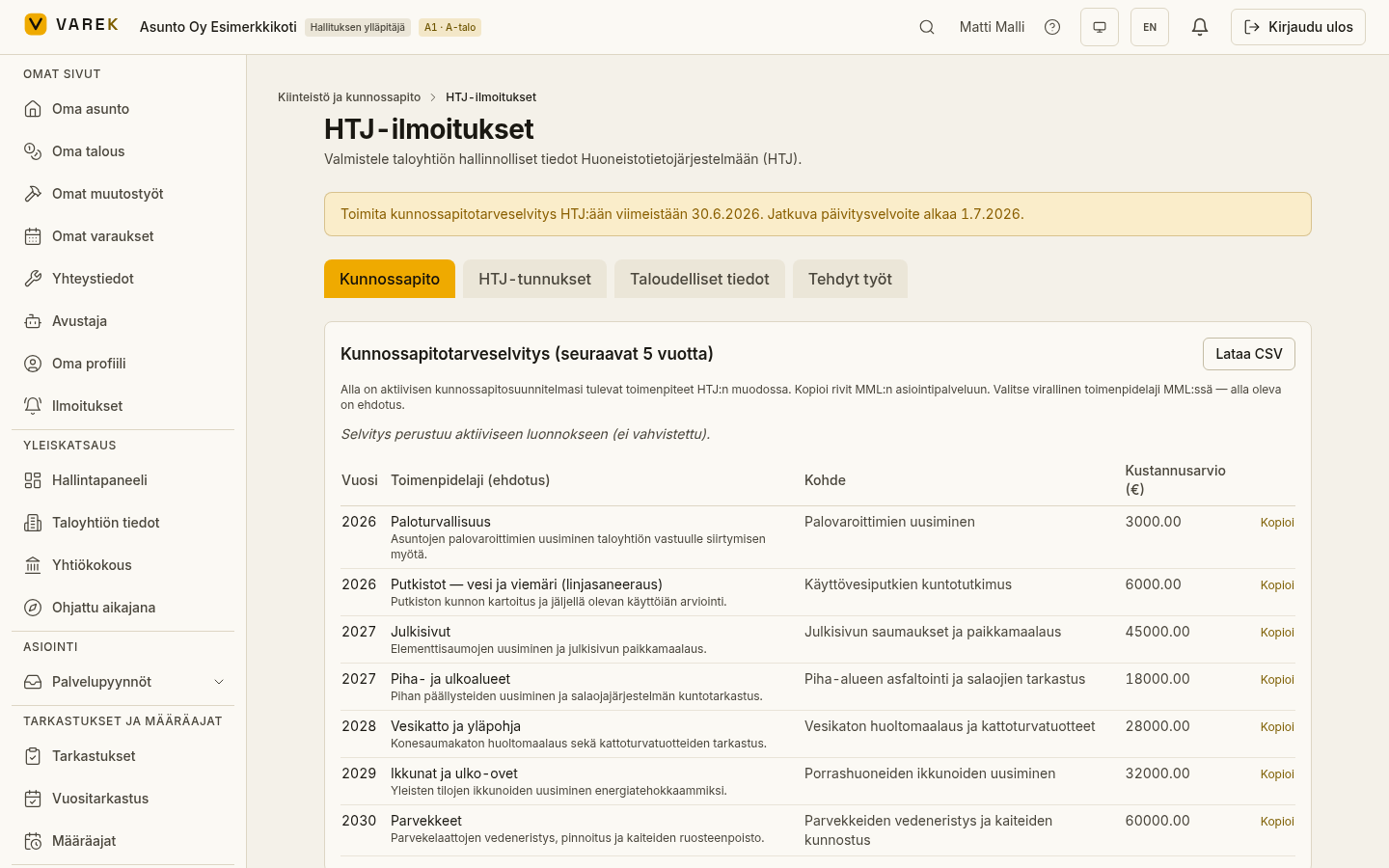
VAREK’s HTJ worksheet compiles maintenance and alteration data ready to be entered into the National Land Survey’s service.
An ongoing duty rewards the systematic
The HTJ notification of maintenance and alteration works is no longer a one-off project but part of the company’s normal annual rhythm. It is light when every completed repair and approved alteration is recorded immediately and the register is updated once a year. Then the company’s repair history is always up to date — for the buyer, the bank, and the next board.
Get in touch and keep your housing company’s maintenance and alteration data ready for HTJ notifications without manual work.
This is a general guide, not legal advice. The data content, deadlines, and exemption conditions of the HTJ obligations may change — always verify the current requirements with the National Land Survey (maanmittauslaitos.fi) or a qualified expert before making a notification. The notification duty and responsibilities for alteration work are determined by the Limited Liability Housing Companies Act (1599/2009) and the company’s articles of association.
Frequently asked questions
Is the HTJ notification of maintenance and alteration works now mandatory?
Yes. Housing companies had to enter their maintenance and alteration data, the maintenance needs assessment, and their basic financial data into the National Land Survey's Housing Information System by 30 June 2026, and from 1 July 2026 the data must be kept up to date continuously as it changes (Housing Information System Act 1328/2018; reporting duties expanded by Act 151/2023). The obligation is therefore now in force, not upcoming. Only the smallest companies are exempt, under specific conditions.
What must be reported about a shareholder's alteration work?
The housing company reports to the HTJ the completed alteration works carried out by shareholders that concern the company's structures — in practice, renovations completed after 1 June 2023. The notification is made by the company, not the shareholder. The shareholder's own duty is to submit a written alteration notice to the board or property manager in advance if the work may affect a structure that is the responsibility of the company or a neighbour (Limited Liability Housing Companies Act 5:2) — that notice provides the company with the information later entered in the register.
How does reporting differ for works completed before versus after 1 July 2026?
Projects completed before 1 July 2026 may be reported more briefly: typically the project name, the main measure, and the year of completion. For works completed from 1 July 2026 onward, more extensive data is reported, such as the type of measure (renewal, repair, alteration, or investigation and planning) and the start and completion years. Always check the current data content from the National Land Survey.
Who makes the HTJ notification when the housing company has no property manager?
The board. If the company has no property manager, the board or a person it authorizes enters the HTJ data. Under AOYL 7:27, the obligation to make the data update referred to in section 17 a of the Housing Information System Act rests with the chair of the board when the company has no property manager or the manager is disqualified.
Is a small housing company exempt from the notification duty?
Some of the smallest companies are, but the conditions are strict. An exemption may apply to a company that has at most five residential shareholding apartments and no company loan distributable to shareholders — both conditions must hold. Even then the exemption is not absolute: if a shareholder, bank, or estate agent requests that the data be updated in the register, it must be reported. Always verify your situation with the National Land Survey before leaving a notification undone.