Financing the PTS repairs: company loan, capitalization, or paying in one go — a board comparison guide
The maintenance needs assessment and the long-term plan tell you what must be repaired in the housing company and when. They do not, however, answer the board’s next question: where does the money come from? The same facade or plumbing renovation can be financed in very different ways, and the choice has a big effect on how much each shareholder ultimately pays, and when. This guide compares the three basic ways to finance a housing company repair — the reserve, the company loan, and the shareholder’s one-off payment — as well as the accounting choice between capitalization and income recognition. Tax is covered only at a general level: the final tax treatment is always confirmed by an accountant.
The three basic financing routes
A housing company repair is financed, in practice, from three sources, most often in combination.
1. A reserve collected in advance. A buffer built up from maintenance charges and funds that is already in the company’s account when the repair begins. The reserve is the cheapest form of financing because no interest is paid on it — but it requires that the repair was anticipated years ahead. This is exactly what the long-term plan aims at: it shows whether the reserve suffices for the coming project or whether a shortfall remains.
2. A company loan + capital charge. The housing company borrows from a bank, and shareholders repay it as apartment-specific loan shares — a monthly capital charge (rahoitusvastike). This is the most common way to finance a large project, because it requires no large one-off payment from shareholders. The mechanics of the company loan and the capital charge — interest, amortization, and euribor — are covered in more detail here: Company loan and capital charge for the shareholder.
3. The shareholder’s one-off project-share payment (hankeosuussuoritus). A shareholder can pay their share of the project cost in one go, from their own funds or funds they arrange themselves, instead of staying in the company loan. In practice many housing companies offer both: the shareholder chooses the one-off payment or the company loan.
Beyond these three, part of the cost may be covered by grants. For example, the state’s energy renovation grant for 2026–2027 is, per the draft, intended to cover up to half of an energy renovation’s cost — but a grant is not the basis of a financing plan, only something that lightens it, and the project should be costed out without it as well. See: Renovation grant for housing companies 2026–2027.
Project-share payment or company loan — the shareholder’s choice
When the housing company offers both, the choice is the shareholder’s. It is the same share of the project cost, paid at a different pace. Each shareholder’s share of the project is usually calculated in proportion to the apartment’s number of shares or floor area — the same basis on which loan shares and charges are otherwise determined.
| Factor | Project-share payment (one go) | Company loan (capital charge) |
|---|---|---|
| Cash flow | A large one-off outlay now | A small monthly instalment |
| Interest | No interest from the company loan | Interest for the whole loan term |
| Cash tied up | Ties up savings or requires an own loan | Keeps cash free |
| Interest-rate exposure | Not exposed to rate increases | The capital charge varies with euribor |
| When often sensible | When there are savings and rates are high | When keeping cash flexible is preferred |
An important note: the shareholder’s choice between a project-share payment and a company loan is a different matter from the housing company’s accounting choice between capitalization and income recognition. They are linked, but decided at different tables — the shareholder decides how to pay, the general meeting decides how to book it.
Capitalization or income recognition — the accounting and tax choice
When capital contributions are collected from shareholders for a repair — as capital charges or project-share payments — the housing company must decide how to record them in its accounts. There are two options, and the decision is made at the general meeting, typically on the accountant’s recommendation.
- Income recognition (tulouttaminen): the contributions are booked as the company’s income. From the company’s point of view the income can be offset against the project’s costs and depreciation, so the outcome is often tax-neutral. For the shareholder, the key point is that an investor shareholder can generally deduct the capital charge from their rental income in the year they pay it.
- Capitalization (rahastointi): the contributions are booked directly to a fund on the balance sheet, not as income. The tax authority then treats the payment as the shareholder’s capital investment, which is added to the acquisition cost of the shares — the deduction happens not in the year of payment but only when the apartment is sold, where the payment reduces the capital gain.
| Income recognition | Capitalization | |
|---|---|---|
| Booking | Company income (income statement) | To a fund (balance sheet) |
| Shareholder’s deduction | Investor can typically deduct from rental income in the year paid | Not in the year paid; added to acquisition cost, taken into account at sale |
| Decision | General meeting | General meeting |
Which is better depends on the situation of the company and its shareholders — among other things, how large a share of the shareholders are investors and how the project is otherwise taxed. This is an accounting and tax question, not a board hunch. Handle the choice together with the accountant and bring it to the general meeting as a reasoned proposal — this guide gives no tax positions.
Paying off the loan share later
Even if a shareholder initially stays in the company loan, they can usually pay off their loan share later, on the dates announced by the company (often when the interest period changes). After a one-off payment, no capital charge is levied on them. Paying off saves future interest but ties up capital — and its tax treatment may differ from the ongoing capital charge, especially for an investment apartment. The terms are announced by the property manager or accountant, and the tax treatment is worth confirming before deciding. Details: Company loan and capital charge for the shareholder.
The board’s checklist for choosing the financing
Choosing the financing method is easier when broken into a few questions:
- Establish the reserve position. How much is in the funds now and how much accrues per year — that determines how large a share of the project has to be financed by a loan or one-off payments at all.
- Cost the project out both ways. Show shareholders both the size of the one-off payment and the estimated monthly capital charge. Many make their choice only after seeing the figures for their own apartment.
- Agree the booking method with the accountant before the general meeting. Capitalization versus income recognition affects shareholders’ taxation, so bring the choice to the meeting as a reasoned proposal.
- Check the division of responsibility. A company loan and a common collection finance only the works that are the company’s responsibility — repairs that are the shareholder’s responsibility are not covered by company financing.
- Account for grants, but do not build on them. If the project collapses without a grant, it is too fragile.
- Take decisions to the general meeting in good time. A significant repair and its financing are decided by the general meeting, not the board alone.
How the PTS models the financing
The options are easier to set against each other when you can see them as numbers. The long-term plan turns the repair measures into a multi-year cash-flow forecast and answers the board’s most important question: is there enough money, and if not, when and by how much does it fall short?
The model starts from a few assumptions the board sets once: the opening reserve (the balance of the funds today), the annual contribution (how much accrues to the reserve per year), and the horizon (3–30 years). From these the reserve’s development is calculated for each year, and the deficit years are marked in red — the board sees at once the year in which the reserve runs out on the current assumptions.
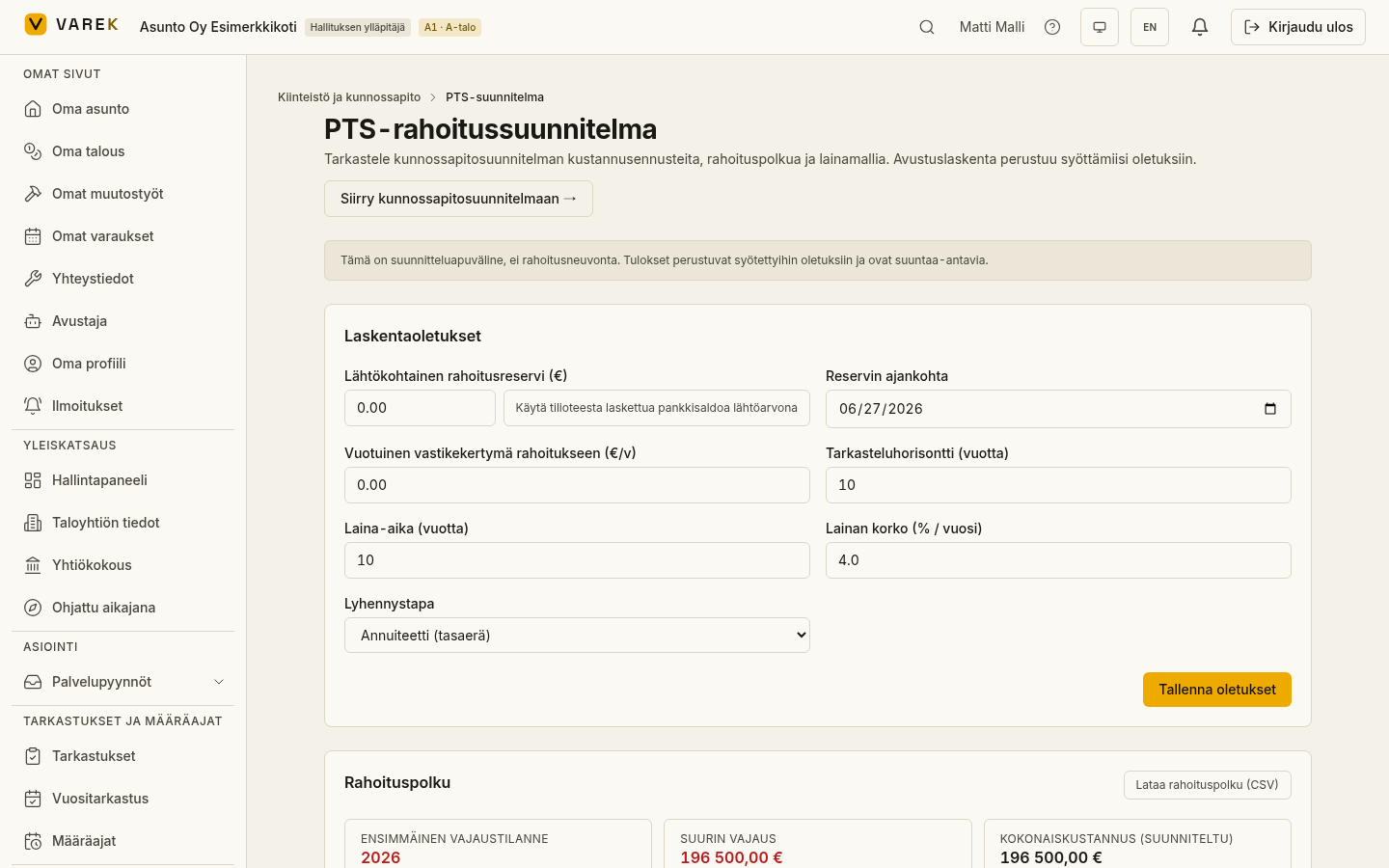
VAREK’s PTS view calculates whether the reserves suffice for the coming repairs — and how large a share is left to be covered by a loan, charges, or a grant.
For a single project the PTS models the company loan: the monthly instalment, the per-apartment capital charge, and the interest over the whole loan term with the annuity or equal-amortization method. The board can thus compare financing options for the same project — how large a charge increase or loan would cover the shortfall, and what it means for the shareholder per month. All the PTS figures are planning assumptions, not promises; they do not replace the assessment of an accountant, property manager, or bank. Guides: PTS — the financing cockpit and Maintenance needs assessment — AI draft.
Keep the repair and its financing in one place
A repair project stays under control when its plan and its financing live in the same data. VAREK brings the chain together: an inspection finding becomes a measure in the maintenance plan, the measure gets a cost estimate, and the PTS calculates whether the reserves suffice or a company loan is needed — and what charge impact each financing option produces. The booking method and tax treatment are decided with the accountant, but the figures the general meeting decides on are ready and traceable.
Get in touch and model your housing company’s repair financing option by option before the general meeting decides.
This is a general guide, not legal or tax advice. The terms of the financing methods, the choice between capitalization and income recognition, and their tax treatment vary case by case — always confirm the solutions with an accountant, property manager, or bank before binding decisions. The figures on the PTS page are planning assumptions.
Frequently asked questions
How is a housing company repair financed?
In three basic ways, often in combination: from a reserve collected in advance (funds, maintenance charges), from a company loan taken by the housing company that shareholders repay as a capital charge, and from shareholders' one-off payments, i.e. project-share payments. In addition, part of the cost may be covered by grants, such as the energy renovation grant now in preparation. The final terms always depend on the bank and the company's situation.
What is the difference between a project-share payment and a company loan?
A project-share payment means the shareholder pays their share of the project cost in one go, from their own funds or funds they arrange themselves. With a company loan, the housing company borrows from a bank and the shareholder pays their loan share gradually as a capital charge. Many housing companies offer both: the shareholder can either pay the project share in one go or stay in the company loan. The choice depends on the shareholder's own finances and the interest rate.
What do capitalization and income recognition mean?
They are two ways of treating the capital contributions collected from shareholders for a repair in the housing company's accounting. In income recognition (tulouttaminen), the contributions are booked as company income, so they can be offset against the project's costs and depreciation; an investor shareholder can typically deduct the capital charge from their rental income. In capitalization (rahastointi), the contributions are booked directly to a fund on the balance sheet, so they are treated as the shareholder's capital investment and are taken into account only when the apartment is sold, as part of the acquisition cost. The decision is made at the general meeting, and the tax treatment should always be confirmed with an accountant.
Is it worth paying off the loan share?
It depends on the interest rate, your own finances, and whether the shareholder intends to keep or sell the apartment. A one-off payment saves future interest but ties up capital; the capital charge keeps cash free but increases the interest cost over time. For an investment apartment the tax treatment of the capital charge and the one-off payment may differ, so confirm it with an accountant before deciding.
How does the PTS help in choosing the financing?
A long-term plan (PTS) turns the repair measures into a multi-year cash-flow forecast and shows the year in which the reserve no longer suffices. With it the board can model how large a charge increase or company loan would cover the shortfall, and compare financing options for the same project before the general meeting decides.