The most common construction defects in new buildings — and how to spot them in time
Even when a housing company has just been completed, that does not mean the building is free of defects. Quite the opposite: new-build developments typically yield the most findings during the first few years. Concrete dries and shrinks, systems have not been fully commissioned, and the pressure of construction schedules leaves its mark. This guide covers the most common construction defects in new-build developments, how to identify each one in time, and which of them require an immediate response.
Why defects occur even in new buildings
Many buyers assume that a new apartment is sound as a matter of course. The reality is different. Construction defects in new-build developments arise mainly from three causes:
- Drying shrinkage. Concrete and timber structures release moisture and change shape during the first one to three years. This causes cracks, joint openings, and movement in sealants.
- Uncommissioned systems. Ventilation, heating, and water circulation need to be balanced and fine-tuned after handover. If commissioning has not been completed, the symptoms show up as draughts, stuffiness, uneven temperatures, or poor indoor air quality.
- Schedule pressure. In the final stretch of the construction phase, work is often carried out under pressure. Waterproofing, sealants, floor slopes, and service penetrations are precisely the details that suffer when time is short.
The key point is that construction-phase defects are the builder’s responsibility during the warranty period — provided they are identified and claimed in time. The warranty period is generally two years from completion, and during this time the burden of proof rests with the builder. Identifying and recording defects before the annual inspection is therefore in the housing company’s interest. The ten-year liability for latent defects is counted from the administrative handover (hallinnon luovutus) — a separate starting point from the two-year warranty period.
The most common construction defects — category by category
The table below lists the most common construction defects in new-build developments, the typical symptoms, when the defect tends to emerge, and a rough severity assessment. Use it as a checklist when inspecting individual apartments and communal areas.
| Defect | Typical symptom | When it appears | Severity |
|---|---|---|---|
| Wet room waterproofing failure | Musty smell, hollow-sounding tiles, damp patches, flaking paint | Months to years after handover | High |
| Floor slope/fall and floor drain errors | Water stands on the floor or flows away from the drain | Immediately on first use | High |
| Unbalanced ventilation | Draughts, stuffiness, persistent moisture in the bathroom, noise | First weeks of occupation | Medium |
| Sound insulation deficiencies | Neighbours’ footsteps, voices or HVAC noises clearly audible | Immediately on moving in | Medium |
| Cracks and drying shrinkage | Hairline cracks in walls, gaps in architraves and sealant joints | Within 1–3 years | Low–medium |
| Window and door seals and alignment | Draughts, condensation, door or window failing to close tightly | First winter | Medium |
| Balcony and facade defects | Standing water on the balcony, cracks or render detaching | Within 1–2 years | High |
| Drainage, grounds, and land drainage errors | Water pooling against the wall, moisture in the basement | During rain and thaw | High |
| HVAC installation errors | Leaking joint, dripping pipe, incorrect flow rates | Immediately or within first months | High |
| Electrical installation errors | Non-functioning socket, incorrectly wired circuit, RCD tripping | Immediately on first use | Medium–high |
| Heating imbalance | Some rooms cold, others too warm | First heating season | Medium |
| Dimensional accuracy errors | Out-of-plumb walls, uneven floors, incorrect levels | Immediately, when measured | Low–medium |
| Surface defects | Scratches, dents, uneven paintwork, sealant errors | Immediately at handover | Low |
Tip: Do not dismiss a “minor” symptom simply because it looks cosmetic. A hairline crack in the facade or a damp patch in the corner of a bathroom can be an external sign of a defect progressing unseen within the structure. Record every observation — including those you cannot yet name.
Wet room waterproofing — the single most serious risk
Wet room waterproofing is the most critical detail in any new-build development. If the membrane does not form a continuous, watertight layer, water penetrates the structure and damage progresses out of sight. Ministry of the Environment decree YMa 782/2017 (on the moisture-technical performance of buildings, replacing the earlier RakMK C2 moisture regulations, finlex.fi) requires that wet room waterproofing be continuous and watertight.
How to identify the defect:
- Tap the tiles with your knuckles. A hollow, drum-like sound indicates that the tile has detached from its substrate and water can reach the membrane layer.
- Use your nose. A musty, cellar-like smell in the bathroom or shower room is often the first sign.
- Look for patches and flaking at the wall-to-floor joint and in the corners.
For a deeper look at symptoms and liability questions, see: Water damage in a new apartment and Wet room waterproofing regulations.
Floor slopes and falls — test with water
An incorrect floor fall is surprisingly common. The floor in a wet room and on a balcony must direct water in a controlled manner to the drain or outlet. If the fall is missing or slopes the wrong way, water stands — and when it freezes, it expands in the joints.
The test is simple: pour a small amount of water on different parts of the floor and watch where it flows. Pooling, or flow away from the drain, indicates a defect. As a rule of good building practice, a wet room floor generally aims for a fall of 1:80 (1:50 in the shower zone), with a minimum fall of 1:100.
Ventilation commissioning — often incomplete at handover
A ventilation system must be balanced and adjusted after handover. If commissioning has not been completed, the symptoms are draughts, persistent stuffiness, moisture remaining in the bathroom after a shower, or an intrusive fan noise. Request the ventilation measurement and commissioning record for the housing company — its absence, or readings outside the specified range, constitutes clear grounds for a claim.
Sound insulation — can you hear the neighbours too clearly?
Sound insulation deficiencies reveal themselves immediately when people move in: neighbours’ footsteps, voices, or plumbing noises are clearly audible. The cause may be inadequate impact sound insulation, a thin intermediate floor, or incorrect service penetrations. Sound insulation is measurable, and a deviation from the required standards is a claimable defect. Read more: Sound insulation in a housing company.
Which defects are urgent
Not all defects demand the same urgency. Distinguish two categories so you can respond appropriately.
Urgent — investigate and claim immediately:
- Moisture and water damage risk. Leaking waterproofing, incorrect floor fall at the drain, a leaking HVAC joint, or standing water on a balcony. Water does not wait — the longer the defect persists, the more extensive and costly the damage.
- Fire safety. Inadequate fire compartmentation, unsealed service penetrations, or incorrect electrical installations. These are subject to requirements at the level of Ministry of the Environment decree YMa 848/2017 (on the fire safety of buildings, finlex.fi), and no flexibility is permitted. For a serious fire-safety deficiency, also notify the building control authority (rakennusvalvonta) or the rescue services (pelastuslaitos) — a contractual claim against the builder does not replace a report to the authorities.
- Structural safety. Railings, staircases, and cracks in load-bearing structures.
Non-urgent — record and bring to the annual inspection:
- Surface cracks, uneven paintwork, minor scratches and dents.
- Aesthetic sealant errors and minor dimensional deviations.
Even a non-urgent defect should still be recorded immediately and claimed no later than the annual inspection. The warranty period does not wait, and an unrecorded defect later becomes the housing company’s own problem.
Protecting your rights — record defects before the annual inspection
Identifying a defect is not enough if it is not documented and claimed in time. The annual inspection is typically held 12–15 months after completion, and it is the last easy opportunity to make defects the builder’s responsibility during the warranty period. Proceed as follows:
- Gather observations systematically. Ask residents — they know their own apartment best. Walk through communal areas and external structures separately. For urgent defects (moisture, fire safety) claim immediately on discovery — do not wait for the full inspection to be completed.
- Document every finding with dated photographs, locations, and descriptions before anything is repaired. Good documentation is the entire foundation of a claim: How to document a construction defect correctly.
- Classify defects by category, severity, and urgency so that the most important ones are progressed first.
- Claim in writing and demand rectification at the builder’s cost — do not accept a verbal promise alone.
Use a ready-made checklist to ensure no category is missed: Annual inspection checklist. Allow time for a thorough walkthrough: Systematic apartment inspection in a new-build development.
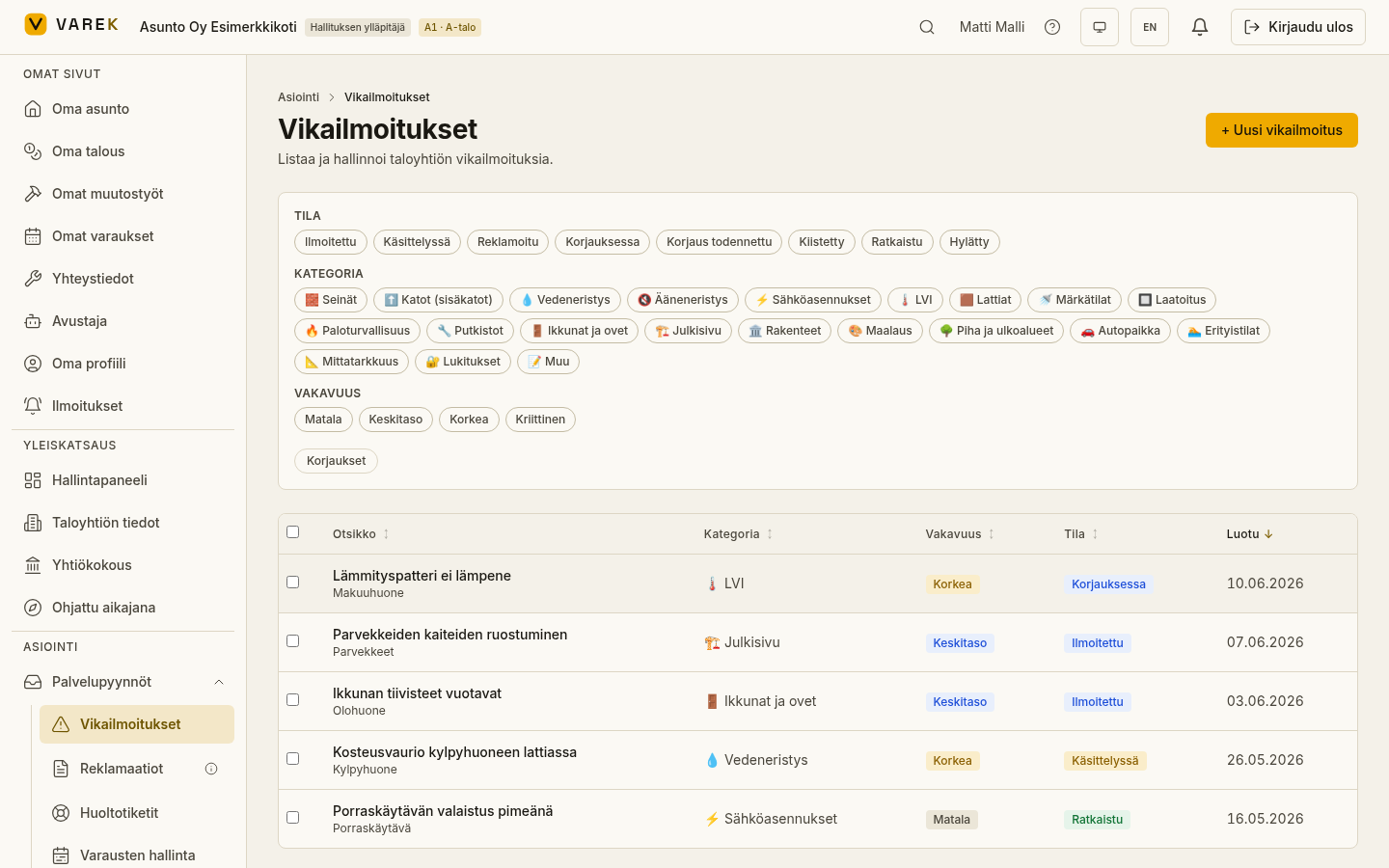
In the VAREK defect list, construction defects are visible in one place — classified by category, severity, and status, so the most urgent ones are progressed first.
When defects are recorded in a single system, it is straightforward for the board to track which defects have been claimed, which the builder has responded to, and which deadlines are approaching. A paper folder or an email thread is not up to carrying a housing company through a ten-year liability period — a structured system is. Note that the ten-year liability covers only latent defects (piilovirheet), and the burden of proof shifts to the housing company after the warranty period ends — the builder is no longer automatically liable for all defects.
Individual apartment buyers’ right to claim against the builder is based on the Housing Transactions Act (asuntokauppalaki, AKL); liability for shared areas and structures may rest with the housing company. Disputes with the builder can be referred to the Consumer Disputes Board (Kuluttajariitalautakunta, KRIL), which issues non-binding recommendations.
Bring observations, claims, and deadlines together in one place
Managing construction defects in a new-build development is a continuous process: observations, photographs, claims, builder responses, and deadlines. VAREK brings all of these together — you record the defect, classify it by category and severity, draft the claim, and track deadlines so that no defect expires unnoticed during the warranty period.
Contact us and make sure your housing company identifies and claims construction defects in a new-build development in time.
This is general guidance, not legal advice. The assessment of defects and the allocation of liability depend on the contract, the stage of the warranty period, and the circumstances — verify the details with a lawyer or a qualified construction expert where necessary.
Frequently asked questions
What are the most common construction defects in new-build developments?
The most frequently recurring defects are wet room waterproofing failures, missing or incorrect floor slopes/falls, unbalanced ventilation, inadequate sound insulation, and shrinkage cracks from concrete drying. Window and door sealing defects, balcony and facade faults, and inadequate drainage and land drainage are also common. The most serious defects relate to moisture and fire safety.
Why do construction defects occur even in a brand-new building?
Even though the building is new, concrete and timber structures dry out and shrink during the first few years, systems are not always fully commissioned, and pressure on construction schedules leads to errors. Some defects are present from the construction phase; others only become apparent in use. This is precisely why the annual inspection matters — it is the last easy opportunity to record defects during the warranty period.
Which construction defects are urgent?
Urgent defects are those that could lead to water damage or pose a fire-safety risk: leaking waterproofing, an incorrect floor fall at the floor drain, a leaking HVAC joint, or inadequate fire compartmentation and service penetrations. These must be investigated and claimed immediately. Cosmetic defects such as surface cracks and uneven paintwork can wait for the annual inspection.
When is the deadline for reporting construction defects?
Defects should be recorded and claimed during the warranty period, which is generally two years from completion. The annual inspection at 12–15 months is the single most important moment, because at that stage the burden of proof still rests with the builder. After the warranty period the builder is only liable for latent defects, and the burden of proof shifts to the housing company. Note that the ten-year liability for latent defects is counted from the administrative handover (hallinnon luovutus), which is a separate starting point from the two-year warranty period.
Who can reliably identify construction defects?
Clear defects — standing water, hollow-sounding tiles, visible cracks — can be spotted by the board and residents themselves through a systematic inspection. In unclear cases, or where defects are concealed within the structure, it is worth commissioning an independent moisture survey or structural assessment. An impartial report pinpoints responsibility and strengthens the claim.