How to document a construction defect properly: photos, measurements and a timeline as evidence
Even a well-founded claim collapses without evidence to support it. When a housing company identifies a construction defect, what ultimately matters is not merely whether the defect exists, but how well it has been documented. A written claim to the builder, proceedings before the Consumer Disputes Board (which issues non-binding recommendations, not binding rulings) and court litigation are all decided on the strength of evidence. This guide explains how to compile photographs, measurements and a timeline into a chain of evidence that stands up to scrutiny — and which are the most common documentation mistakes to avoid.
Why documentation decides the outcome
A verbal complaint is not enough, and it leaves no trace. Only written and photographic documentation creates a chain of evidence that can be relied upon later. This is particularly important once the warranty period has expired and the burden of proof has shifted to the housing company: the housing company must then demonstrate for itself that the issue is a construction defect rather than normal wear and tear. Read more about how liability and the burden of proof are allocated: Warranty period and ten-year liability.
The legal basis for such a claim is generally Chapter 4 of the Housing Transactions Act (843/1994): a dwelling or building is defective if it does not conform to what can be considered agreed — for example the plans, building regulations or good construction practice. A claim does not, however, advance on the strength of a statutory provision alone. A court or the Consumer Disputes Board (KRIL — Kuluttajariitalautakunta) will assess whether the defect is visible in the material submitted, and it is precisely at this point that many otherwise well-reasoned cases fail.
Good documentation is the foundation of the entire claim. Before you draft a defect notice, gather your evidence — otherwise your claim rests on recollections alone: Making a written claim to the builder: how to do it correctly and on time. Bear in mind too that the material must be retained for the full period of liability. Under the Act on the Limitation of Debts (728/2003), an open claim becomes time-barred after approximately three years from when the basis for the claim was or should have been known, unless renewed — verify the exact deadline with a lawyer for your specific circumstances, so the original evidence must remain safe and retrievable even years later.
What makes documentation valid evidence
Valid evidence is not simply a matter of volume. Three characteristics determine whether material will withstand scrutiny:
- Objectivity. Document observable facts — what is visible, where and to what extent — not interpretations or accusations. A photograph of a crack and a measurement result say more than the phrase “poor workmanship”.
- Dating. Every observation and photograph must be datable. The date shows when the defect existed and that it was reported in time — for example during the warranty period or immediately after a latent/hidden defect came to light.
- Traceability. The material must form an unbroken chain from observation to claim: who observed it, where, when, what the photographs and measurements show, and which written claim they relate to.
When all three conditions are met, a single photograph is transformed from an isolated snapshot into part of a credible whole.
Photographs — doing it right
A photograph is the single most important piece of evidence, but only if it is taken correctly. A good set of photographs always combines two perspectives:
- A context shot shows where the defect is — the full wall, the corner of a bathroom, part of a flat. Without context, a close-up stands alone.
- A close-up shows what the defect is — a crack, a damp stain, incorrect drainage fall, a loose joint.
Apply these principles to every set of photographs:
- Include a scale reference. Place a tape measure, ruler or other known object next to the defect in the close-up so that the size of the damage is clear. “A large crack” is an interpretation; a 3 mm crack visible alongside a tape measure is a fact.
- Verify the date. Check that your camera clock is correct and that the date is embedded in the image metadata. An undated photograph loses much of its value.
- Photograph from multiple angles. A single shot can distort proportions or leave something important in shadow. Multiple angles demonstrate that the issue is not a photographic artefact.
- Capture before, during and after. For progressive or repaired damage, take photographs at the moment the defect is discovered, during any repair work and afterwards — so that the adequacy of the repair is also documented.
Tip: take more photographs than you think you need. Material can always be culled, but a missed moment of observation cannot be recovered — the damage will have changed or been concealed in the meantime.
Measurements and conditions
Some defects are visible in a photograph; others only become apparent through measurement. Moisture, slope, temperature and noise levels are typical examples of measurable quantities. Minor measurements can be carried out by the housing company itself, but precise measurements that will be decisive in a dispute are best carried out by a qualified expert — an impartial measurement report is clearly stronger evidence than your own assessment. Read about when external help is advisable: When does a housing company need an external building expert.
| Defect type | What to measure / document | Is a professional needed? |
|---|---|---|
| Moisture and water damage | Surface moisture and structural moisture content (%), extent of damage, odour observations | Yes, for structural moisture and cause of damage |
| Floor drainage fall and water evacuation | Direction and gradient of fall, standing water, threshold heights | Yes, for precision measurement |
| Sound insulation | Description of the disturbing sound, time of occurrence, impact or airborne noise | Yes, for measuring the sound-insulation index |
| Cracks and settlement | Width and length (tape measure), location, progression over time | Yes, for structural cracks |
| Heat and draught | Temperature, sensation of draught, possible thermal-imaging photograph | Yes, for thermal imaging |
| Surface and finishing defects | Photograph, scale reference, location, extent | Generally no |
Always record the value, time of measurement, point of measurement and the method or instrument used. A bare figure without contextual information is easily disputed.
Conditions also matter for interpretation. A moisture reading varies with the season and indoor air humidity; a sound problem may only be audible at certain times of day; and a crack may move with temperature. A single measurement therefore rarely suffices: record the conditions and repeat the measurement as necessary to distinguish a random deviation from a persistent defect. For progressive damage, a repeated measurement at the same point is often stronger evidence than any single reading.
Timeline and written description
Photographs and measurements need a written description alongside them to bind the observations together. A good defect record always answers the same questions:
- When was the defect discovered? An exact date, and ideally the circumstances (for example, “after the first frost”).
- Who discovered it? A shareholder, a board member, the property manager or an external inspector.
- Where is the defect located? The building, the flat or the communal area, and the precise spot.
- How has the defect progressed? Has a damp patch spread, a crack widened, a noise worsened? Progression is often the strongest indication that the issue is not a superficial blemish.
The timeline is particularly important for meeting deadlines. It demonstrates that the defect was reported on time — visible defects by the annual inspection at the latest, and hidden/latent defects as soon as they come to light. The same timeline also helps you remember to renew the claim before the three-year limitation period, so that your claim does not lapse unnoticed.
Record all correspondence with the builder on the timeline as well: written claims submitted, the builder’s responses, agreed repair schedules and repairs carried out. This is often decisive when the builder claims to have remedied the defect, or denies ever receiving the claim. A dated entry such as “claim submitted 12 March, response received 28 March, repair promised for May” turns a dispute into a matter of fact. If the builder delays or contests liability, this unbroken sequence of events is the housing company’s strongest asset.
Bring everything together in one system
Individual photographs and notes are only valuable if they can be found when needed — often years later. The typical problem is that material is scattered: photographs on the mobile phones of board members, measurements buried in emails, descriptions on slips of paper. In a dispute, it is almost impossible to reassemble the whole picture.
The solution is to record each defect immediately in a single system that keeps photographs, dates, measurements and descriptions in the same place. VAREK consolidates defect report data — category, location, severity, description and attachments — into one traceable piece of evidence that feeds directly into the written claim.
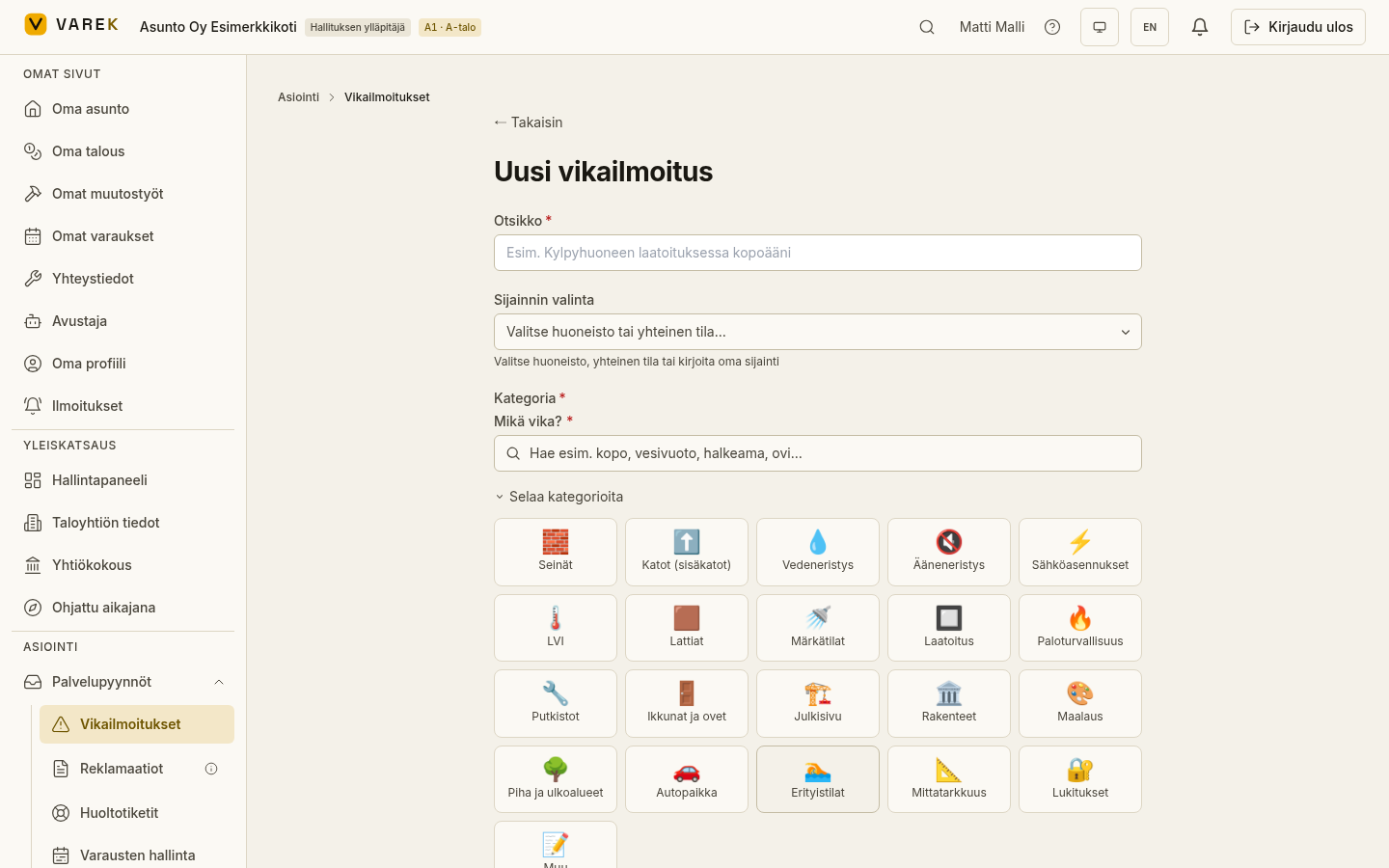
The VAREK defect report form brings the category, location, severity and description of a defect together as a single dated piece of evidence — the same material passes directly into the written claim.
When every defect is recorded in the same way, the entire history of the housing company remains consistent and the chain of evidence is always available. This is especially important in new-build properties, where multiple defects may accumulate: The most common construction defects in new-build properties.
The most common documentation mistakes
Most lost cases fail not because the defect did not exist, but because of gaps in documentation. Avoid these:
- A verbal complaint only. A phone call or a corridor conversation leaves no trace. Always notify in writing and keep a copy.
- Undated photographs. Without a date, a photograph cannot show when the defect existed or that it was reported on time.
- Close-ups without a scale reference. Without something to compare against, the size of the damage becomes a matter of interpretation.
- Scattered material. When photographs, measurements and descriptions are in different places, it becomes impossible to reassemble the picture — and it is the complete picture that decides the outcome.
- Failure to record progression. A single snapshot does not show whether the damage is worsening. Repeated, dated monitoring is often the strongest evidence.
- Forgetting to document the repair. If the builder carries out an inadequate repair, it is very difficult to prove the work fell short of requirements without before-and-after photographs.
If you suspect that an observation is not yet clear enough to constitute a construction defect, record it anyway — a hidden/latent defect that emerges later, or proceedings before the Consumer Disputes Board (KRIL), will rely on precisely these early records.
Build your evidence file now
Documentation is not bureaucracy — it is the housing company’s best insurance: without evidence, even the strongest legal right goes unenforced. VAREK helps you record every defect correctly at the moment of observation — photographs, dates, location and description all in one place — and compiles them ready for the written claim, while sending deadline reminders.
Contact us and make sure your housing company’s evidence will stand up to scrutiny when it matters most.
This is a general guidance article, not legal advice. The specifics of burden of proof, limitation periods and the sufficiency of evidence depend on the contract and the circumstances — verify these with a lawyer or a qualified expert as necessary.
Frequently asked questions
Why is documenting a construction defect so important?
Written claims, proceedings before the Consumer Disputes Board (KRIL — which issues non-binding recommendations, not binding judgments) and court cases are all decided on the basis of evidence. A verbal complaint leaves no trace. Only dated, traceable and objective documentation — photographs, measurements and a written timeline — proves that a defect is real, when it was discovered and how it has progressed. Weak documentation can sink an otherwise well-founded claim.
What photographs should I take of a construction defect?
Always take both a context shot (showing where in the room the defect is located) and a close-up (showing the detail of the defect itself). Include a scale reference in the close-up — a tape measure or ruler — so that the size is clear. Photograph from multiple angles and make sure the date is embedded in the image data. For recurring or progressive damage, take photographs before, during and after any intervention.
Do I need professional measurements, or is my own documentation enough?
Careful documentation by the housing company is sufficient for recording the defect and submitting a claim. However, precise technical measurements — moisture content deep in the structure, sound-insulation index, slope measurement with calibrated instruments — are best carried out by a qualified expert, especially when liability is disputed or the defect is serious. An impartial measurement report is considerably stronger evidence than your own assessment.
What are the most common documentation mistakes?
The most typical mistakes are: a verbal complaint with no written record; undated or scale-free photographs; and evidence scattered across emails, mobile phones and paper notes so that no coherent picture can be assembled later. Failing to record when the defect was first noticed and how it has progressed also weakens the evidence significantly.
How long must the documentation be retained?
Keep all material relating to a construction defect for at least the full period of liability — throughout the warranty period and beyond the ten-year liability period. An open claim generally becomes time-barred after approximately three years from when the basis for the claim was or should have been known, unless renewed — verify the specific deadline with a lawyer. The original evidence, the written claims and the builder's responses must be kept safe and accessible at all times.